
Last updated: July 19, 2026
The Fern That Grows Its Own Rare-Earth Ore
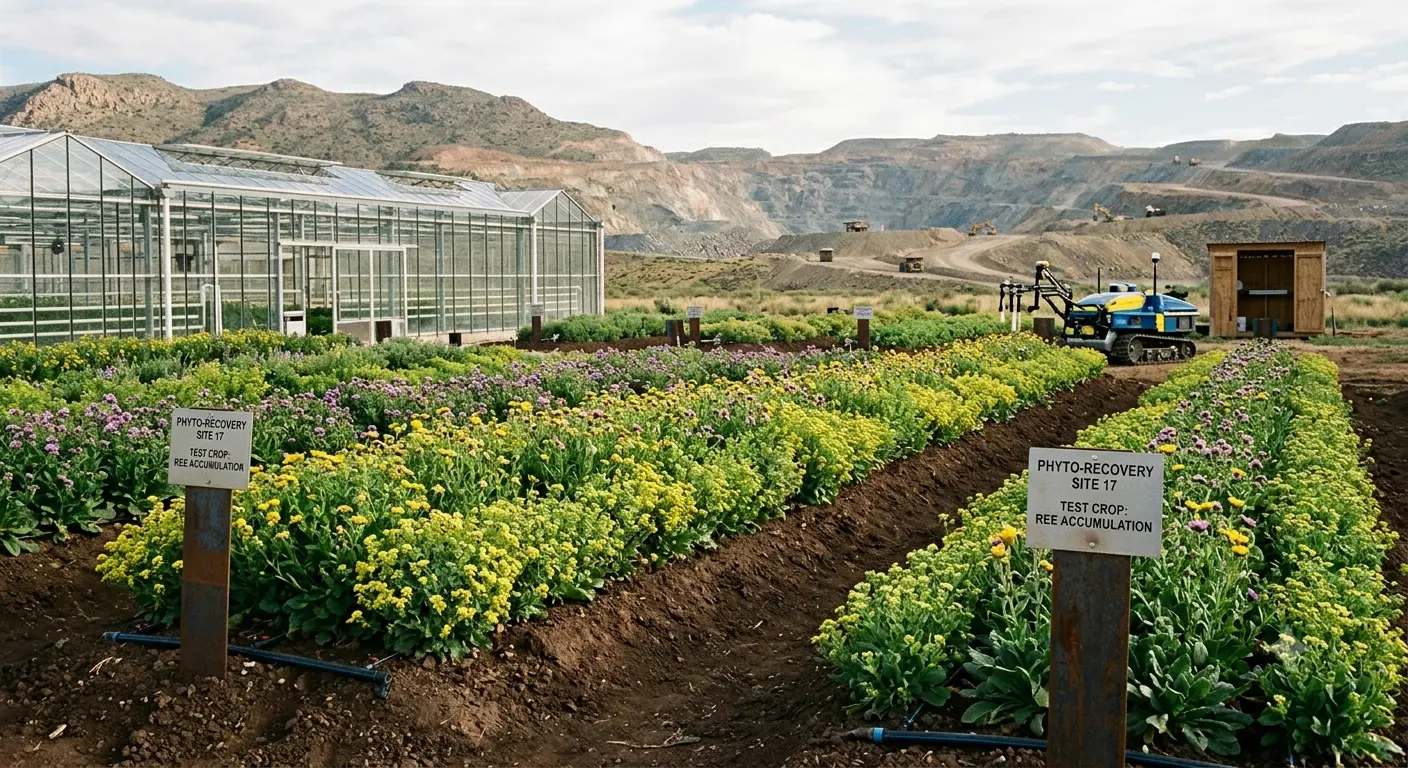
On a weathered hillside in southern China, a scrambling fork fern called Dicranopteris linearis pulls rare earth elements out of the ground and packs them into its fronds until they make up as much as 0.7% of the leaf by dry weight — a concentration hundreds to thousands of times higher than the soil it grows in, and rich enough that the plant is effectively growing its own low-grade ore. Phytomining is the idea of doing that on purpose: planting metal-hoarding species on metal-rich land, harvesting the crop, and burning it down to an ash that carries the metal in concentrated form. Nickel is already farmed this way at commercial scale. Rare earths are the newer, harder prize, and the reason the prize matters is a single country.
China refines roughly nine in ten of the world’s rare earths and almost all of the heavy ones, and across 2025 and 2026 it turned that dominance into leverage, putting the exact elements the West cannot easily source anywhere else under export licensing. That is what gives a field of ferns its strategic charge. A plant-grown supply of rare earths would sit outside China’s licensing regime by definition — it comes off farmland, not out of a controlled mine. The catch, and the honest thesis of this article, is that phytomining reaches only one end of the problem: it can loosen the grip on digging up rare earths, but it does nothing about the step where China’s control is tightest — separating and refining them.
Why Farm Rare Earths Instead of Mining Them?
Rare earths are not geologically rare; what is scarce is a way to get them that does not run through China. Conventional extraction struggles precisely where phytomining is strongest — on ground where the metal is spread too thinly, or the land too degraded, for a mine to pay. The richest plant-accessible rare earths sit in ion-adsorption clays grading a fraction of a percent, and in the tailings and spoils left behind after those clays are leached. A crew with excavators cannot economically chase metal at that grade across a hillside; a crop can, because it does the concentrating for free as it grows, and it can do it on land that is otherwise written off.
That is the real case for plants, and it is worth stating plainly what it does not include. Phytomining produces a mixed rare-earth concentrate, not a finished magnet metal. The bio-ore still has to go through the same acid leaching and, above all, the same element-by-element solvent-extraction separation that is the actual chokepoint China controls. Farming the ore changes where the raw material comes from; it does not change who can turn that raw material into separated dysprosium or terbium.
| Approach | Works best on | Capital & footprint | Which bottleneck it addresses |
|---|---|---|---|
| Conventional hard-rock / clay mining | Higher-grade ore bodies and rich ion-adsorption clays | High capital; large excavations; acidic and often radioactive tailings | Access to ore — the stage the world is least short of |
| Rare-earth phytomining | Low-grade clays, mine tailings, contaminated and marginal land | Low capital; farm-scale; stores carbon and stabilises soil | Adds ore outside China’s licensing regime — but not refining |
| Separation & refining (solvent extraction) | Any concentrate, including bio-ore | Hundreds of chemical stages; the hardest capacity to build | The true chokepoint — ~90%+ of it sits in China |
How Hyperaccumulator Plants Pull Rare Earths From the Soil
A hyperaccumulator does the one thing almost every other plant evolved to avoid: it lets a heavy metal into its tissue on purpose and thrives on it. Ordinary plants treat rare earths as poison and block them at the root. Hyperaccumulators instead draw the metal ions up the transpiration stream and lock them away safely — in Dicranopteris linearis, researchers have traced lanthanum and cerium to the leaf epidermis and the dying frond tips, immobilised in the cell wall by a silicon–pectin matrix that binds the metal where it can do no harm. One 2025 study went further and found a fern quietly biomineralising nanoscale monazite, an actual rare-earth phosphate mineral, inside its own tissue — a plant not just storing rare earths but crystallising them into ore.
Because the metal ends up in the leaves and stems, the harvest is simply the above-ground crop, and the recovery route is short enough to write as a sequence:
- Plant hyperaccumulators on rare-earth-bearing ground — ion-adsorption clay soils, mine tailings, or land too contaminated for ordinary crops.
- Grow and then harvest the above-ground biomass at the end of the season, where the rare earths are stored.
- Dry the biomass and heat it to burn off the carbon, concentrating the metal into a mineral-rich ash, or “bio-ore.”
- Leach the ash with dilute acid to dissolve the rare earths out of the residue.
- Separate and refine the individual elements using conventional rare-earth chemistry.
From Field to Bio-Ore: Recovering the Metal After Harvest
For years the whole chain jammed at one step: turning dried plant into leachable ash. Roasting biomass slowly in a furnace drove the rare earths into stable mineral phases that resisted acid, so recovery was poor and the energy bill was steep. A 2026 study in Communications Materials from Bing Deng’s group at Tsinghua University rewrote that step with rapid electrothermal calcination — a jolt of current that flash-heats the dried biomass to about 1,000°C in roughly 20 seconds, against the 550°C and three hours of a conventional furnace. The burst blows off the volatiles so violently that it leaves a porous carbon skeleton behind, and that open structure gives up its metal readily.
The numbers are what make it matter. The flash method recovered about 97% of the rare earths in ordinary dilute-acid leaching, against roughly 90% for the furnace route, using a quarter of the energy — 74 kilowatt-hours per kilogram of biomass versus 288 — and cutting the carbon emissions of the step by more than 70%. It also leaves far less iron and aluminium behind to purify out later. That single processing gain is the main reason rare-earth phytomining reads as more credible in 2026 than it did five years earlier.
Which Plants Hyperaccumulate Rare Earths
Two species carry most of the rare-earth phytomining research, and they could hardly be less alike: a subtropical fork fern that blankets southern Chinese hillsides, and a roadside weed North American gardeners spend their weekends pulling out. The fern Dicranopteris linearis and pokeweed (Phytolacca americana) both pack more than 1,000 mg of rare earths into every kilogram of dry leaf, but they specialise in opposite directions — the fern toward the abundant light rare earths, pokeweed toward the scarcer, more valuable heavy ones. That split is the useful part, because the heavy rare earths are exactly the elements China controls most tightly.
| Species | Type | Rare earths it favours | Reported concentration |
|---|---|---|---|
| Dicranopteris linearis (a fork fern) | Fern | Light rare earths — lanthanum, cerium, neodymium, praseodymium | Commonly >1,000 mg/kg; up to ~7,000 mg/kg (0.7 wt%) in leaves |
| Pokeweed, Phytolacca americana | Herb | Heavy rare earths, preferentially routed to the leaves, plus manganese | Leaf ~250–1,040 mg/kg; roots far higher in trials |
| Blechnopsis orientalis & other ferns | Fern | Light rare earths; one species biomineralises monazite | Up to ~4,000–4,300 mg/kg |
How Much Rare Earth Can a Fern Accumulate?
Consistently more than a tenth of a percent of its dry weight, and at the top end close to 0.7%. Every southern-Chinese population of Dicranopteris linearis ever measured clears the 1,000 mg/kg hyperaccumulation bar, and it does so even where the soil holds as little as 15 mg/kg of total rare earths — an enrichment that turns thin ground into a harvestable grade. The fern reliably favours the light rare earths regardless of what it is rooted in, which makes it a dependable crop for lanthanum, cerium and neodymium but a poor one for the heavy elements the market is most desperate for.
Does Pokeweed Accumulate Rare Earths?
Yes, and it is the more surprising of the two workhorses. Phytolacca americana grows wild across North America and East Asia, hoarding rare earths and manganese in its leaves without any prompting — the same appetite that makes it a nuisance in a flower bed makes it a specimen in a rare-earth lab. What earns it real attention is the fractionation: in controlled trials pokeweed preferentially moved the heavy rare earths up into its leaves, the opposite of the ferns, and it is exactly those heavy elements — dysprosium, terbium, yttrium — that sit behind China’s tightest export controls. A DARPA-funded project at North Carolina State University is now studying pokeweed for that reason, pairing it with acid-mine-drainage cleanup in Appalachia and using spectroscopy to time the harvest for peak metal content.
Beyond the two workhorses, the roster of known rare-earth plants is growing fast, because researchers stopped waiting on field surveys. Screening preserved herbarium specimens with handheld X-ray fluorescence, teams have checked thousands of pressed plants filed decades before anyone thought to test them: a 2024 Paris survey ran across 4,425 specimens, and a 2025 Australasian screen turned up eleven previously unrecognised hyperaccumulator ferns. The trait, it turns out, is far more common among ferns than anyone assumed.
Ion-Adsorption Clays: Where Rare-Earth Phytomining Fits
The reason a fern can mine at all comes down to how the rare earths are held in the ground. In the warm, wet hills of southern China, rare-earth-bearing granite has weathered over millions of years into ion-adsorption clays — deposits where the metal is not locked inside hard minerals but clings loosely to clay surfaces as exchangeable ions. Industrially, miners flush those ions out with ammonium-sulfate solution; a plant root does much the same thing biologically, swapping its own ions for the rare earths and drawing them up. Roughly 60 to 90% of the contained rare earths sit in that loosely bound, plant-reachable form, which is precisely why Dicranopteris thrives on this ground and hyperaccumulates as it grows. The clays are also the world’s main source of heavy rare earths like the yttrium and gadolinium that go into fusion’s superconducting magnets — the same supply chain, approached from the soil rather than the smelter.
These same clays supply much of the world’s heavy rare earths and are scattered across southern China, and they leave behind enormous areas of leached, acidified, erosion-prone spoil once mined. That degraded aftermath is phytomining’s natural home: land already stripped of easy metal, where a hardy fern can pull up the remaining rare earths, hold the soil together, and reclaim a site a conventional operation has finished with. The near-term prize is not a mountain’s worth of tonnage but the ground a mine cannot justify touching twice.
How Much Rare Earth Can Phytomining Realistically Supply?
Not enough to replace a mining industry, and it is important to be honest about the gap. Nobody is harvesting rare earths from plants at commercial scale as of 2026; nickel is the only metal farmed that way for real. The best current modelling, published in Communications Earth & Environment in April 2026, puts a well-run Dicranopteris crop at 5 to 22 tonnes of biomass per hectare, yielding somewhere between 8 and 300 kg of rare earths per hectare depending on the site. Set that against world production of around 390,000 tonnes a year and the arithmetic is unforgiving.
| If a phytomining programme aimed to supply… | Land needed (~100 kg REE/ha, mid-range) | Share of ~390,000 t mined each year |
|---|---|---|
| 100 t of rare earths / year | ~1,000 hectares (~2,500 acres) | ~0.03% |
| 1,000 t / year | ~10,000 hectares | ~0.26% |
| 10,000 t / year | ~100,000 hectares (~1,000 km²) | ~2.6% |
Those rows assume a mid-range 100 kg/ha; at the low end of the modelled yield the land needed grows more than tenfold. Even the optimistic case would take an area the size of a small country to move the global needle — which is why the credible role is a targeted one: high-value heavy rare earths harvested from tailings and marginal clay, not bulk tonnage competing with a mine.
Nickel shows what a mature version looks like, and why rare earths still trail it. Field trials of the nickel crop Odontarrhena chalcidica pull roughly 55 to 150 kg of nickel from a hectare in a single harvest, and in good conditions nickel makes up about a fifth of the resulting ash — a genuinely rich bio-ore. Rare earths accumulate to fractions of a percent rather than whole percent, so their ash is far leaner, and the economics only close in special cases. As the 2026 modelling team put it, phytomining “is unlikely to replace conventional mining, but it can be integrated with conventional mining to create a more circular and value-added approach to resource extraction.”
The Companies Already Farming Metal From Plants
Rare-earth phytomining has no commercial operator yet, but the business model it would follow is already running on nickel — and the money moving into metal-farming startups is the clearest signal that the wider idea is being taken seriously. These are the ventures proving the value chain works, even if their metal is not rare earths yet.
| Venture | Metal & approach | Where it stands (2026) |
|---|---|---|
| Genomines (France) | Gene-edited nickel hyperaccumulators | Raised a $45M Series A in Sept 2025; scaling pilots, targeting battery-grade nickel |
| Metalplant (Albania) | Nickel farming paired with enhanced rock weathering for carbon removal | Field plots on serpentine soil; sells nickel plus verified carbon drawdown |
| Econick (France) | Bio-sourced nickel salts from harvested biomass | Université de Lorraine spinout; scaling from lab to industrial batches |
| NC State / DARPA (USA) | Pokeweed for heavy rare earths + acid-mine-drainage cleanup | Research programme; the leading rare-earth-specific effort |
The nickel names are the furthest along. Genomines, a Paris company founded by Fabien Koutchekian and Dali Rashid, closed a $45 million Series A in September 2025 co-led by Engine Ventures and Forbion, with Hyundai Motor Group among its backers; it says its gene-edited plants have more than doubled nickel yields over wild hyperaccumulators. Metalplant, working serpentine soils in northern Albania, bolts phytomining onto enhanced rock weathering so the same fields draw down carbon dioxide, selling the nickel and the verified carbon removal as two products. On the rare-earth side specifically, the sharpest activity is academic: alongside the Tsinghua processing work, a DARPA-funded team at North Carolina State is developing pokeweed as a heavy-rare-earth crop tied to mine-land reclamation. It is a field of research groups and early ventures, not yet a field of producers.
What Rare-Earth Phytomining Means for the Supply Squeeze
To see why a fringe technology draws serious funding, look at the market it is aimed at. Rare earths are not scarce in the ground — the United States is still about 67% reliant on imports despite sitting on sizeable reserves — the scarcity is manufactured downstream. China mines roughly 69% of the world’s rare earths but refines about 91% of them and makes some 94% of the world’s rare-earth magnets, and its grip on the heavy rare earths that keep those magnets working in a hot motor runs close to 98%. Mining is where the world has options; refining is where it has none, and that is the stage phytomining does not reach.
That imbalance stopped being theoretical in 2025. On 4 April 2025 China placed seven medium and heavy rare earths — samarium, gadolinium, terbium, dysprosium, lutetium, scandium and yttrium — under export licensing, and in October 2025 it escalated with a rule reaching any magnet worldwide containing even 0.1% Chinese-origin heavy rare earths. A November 2025 truce suspended that escalation for one year, but the suspension lapses in November 2026 and the April licensing regime remains fully in force — a live cliff hanging over every buyer outside China. The price signal follows the control: terbium metal traded near $1,280/kg inside China in mid-July 2026, while Western buyers locking in long-term ex-China supply have accepted floors around $2,050/kg, roughly double.
Phytomining’s appeal against that backdrop is partly environmental, and that too is a market signal. Conventional rare-earth refining is brutally dirty — a widely cited Chinese industry estimate puts the toxic waste at roughly 2,000 tonnes per tonne of rare earth produced, including radioactive thorium residue — whereas a plant crop stores carbon and reclaims land as it works. The economics can even flip favourable in one specific case: recovering bulk oxides from bio-ore is worth only about $464 per hectare and costs more than conventional mining, but converting the harvested biomass directly into rare-earth catalysts or specialty materials could be worth more than $10,000 per hectare, according to the 2026 modelling — the difference between competing on a commodity and selling a finished product.
What Rare-Earth Phytomining Means for Investors
The investable reality is narrower than the headlines. Because phytomining touches the ore, not the separation plant, it is not a fix for the bottleneck that actually moves rare-earth prices, and there is no pure-play rare-earth phytomining stock to buy — the ventures nearest to commercial (Genomines, Metalplant, Econick) are private and, for now, nickel-focused. The listed exposure to the broader squeeze sits elsewhere: in the ex-China refiners racing to break the monopoly, such as Lynas — which in 2025 became the first company to separate heavy rare earths outside China — and MP Materials in the United States. Phytomining is best read as a long-dated option on marginal-land supply and mine reclamation, carrying real technology and timeline risk, not as a near-term answer to the refining chokepoint.
The Outlook for Phytomining in the Rare-Earth Supply Chain
The plausible role over the next decade is narrow but real: reclaiming mine tailings and spent ion-adsorption clay, and supplying modest volumes of scarce heavy rare earths, rather than going head-to-head with industrial mines. Three things have to keep moving for even that to arrive, and all three already are. Processing had to become efficient, and the 2026 flash-calcination result is the first hard sign it can. More hyperaccumulator species have to be found, and herbarium X-ray screening is turning them up faster than field surveys ever did. And the economics have to close, which export controls and climbing ex-China heavy-rare-earth prices are doing from the other side of the ledger, helped by fresh public money — the US Department of Energy opened phytomining research funding in 2024.
Put those together and the credible 2030 picture is a handful of pilot operations on mine-scarred land where the soils cooperate — southern China, Southeast Asia, and pockets of North America — feeding small volumes of heavy rare earths into a market that will take any supply it can get from outside one country’s licensing regime. The November 2026 expiry of China’s suspended controls only sharpens that incentive. This is a fast-moving research field; the figures here reflect the state of the science in mid-2026 and are worth rechecking each year.
A Short History of Hyperaccumulator Plants
Hyperaccumulation was named long before “critical minerals” became a policy phrase. In 1976, botanists working in New Caledonia described a tree, since renamed Pycnandra acuminata, whose blue-green latex ran up to about a quarter nickel by dry weight — an image so startling it launched a field. A year later Robert Brooks and colleagues coined the word hyperaccumulator and set the definition still used today: a plant carrying more than 1,000 mg of a target metal per kilogram of dry leaf.
The leap from curiosity to resource came in 1983, when the US agronomist Rufus Chaney proposed that such plants could be farmed to recover metal — the idea now called phytomining. Nickel led because its hyperaccumulators are numerous and its chemistry forgiving; more than 500 nickel-accumulating species are known, and by 1998 researchers had shown the trick could be extended to gold. Rare earths are the newest frontier, riding four decades of nickel research into a supply crisis that has finally made the question urgent.