
Published: July 23, 2026
Silver in Solar Panels
Every silicon solar panel on Earth carries a few grams of silver, printed across the cell as a web of fine lines thinner than a hair. It is there for one reason: silver is the most electrically conductive metal known, so nothing else pulls power off a solar cell with so little loss, through such fine lines, over so many years. That makes silver the performance choice — and it also makes it a target, because with silver at record prices the metal has become the single most expensive ingredient in a modern cell. The result is an industry spending real engineering effort to use less of the best material it has, and total solar silver demand has actually started to fall even as installations hit record highs.
This article covers how silver works inside a solar cell, how much is in a panel and how it varies by cell type, why the industry is thrifting silver, and — the part most coverage skips — what that cost-cutting actually trades away: efficiency, reliability, lifespan and recyclability. It then looks at how solar feeds the silver deficit, what’s driving solar’s growth, and where demand could go through 2050 under both the “keep cutting silver” and “silver holds its ground” paths. Every figure is dated and sourced.
Why Silver Is the Metal in Every Solar Cell
Silver is used because it has the highest electrical conductivity of any element, which lets it carry a cell’s current through the thinnest possible lines while shading the least silicon — and it resists corrosion, so it keeps doing that for decades outdoors. That combination of conductivity, fine-line printing and durability is why silver was chosen when the first practical solar cells were built, and why it has never been fully displaced. Every candidate replacement is a step down on at least one of those axes: it is a trade against the benchmark, not an upgrade of it.
That distinction matters for everything that follows. Silver is not being reduced because engineers found something that works better — it is being reduced because it is expensive, and the entire thrifting-and-substitution effort is a cost play, not a performance one. Understanding that reframes the whole story: the question is not whether the industry can use less silver, but what it gives up when it does. Silver’s broader role across the economy is covered in our guide to the future uses of silver, and the other materials in a panel in our overview of solar panel materials.
How Silver Gridlines Collect a Cell’s Current
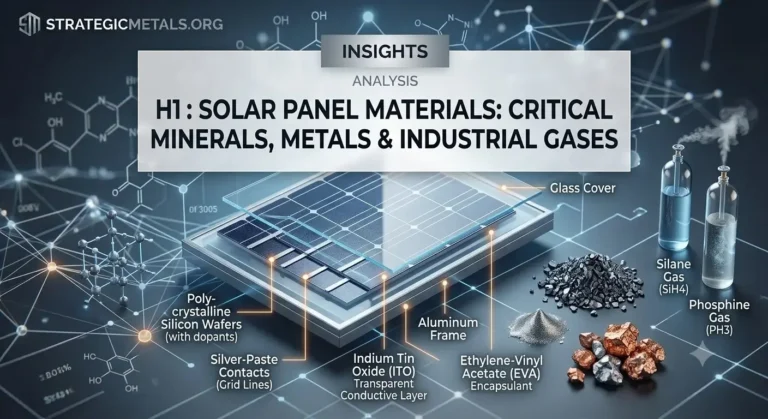
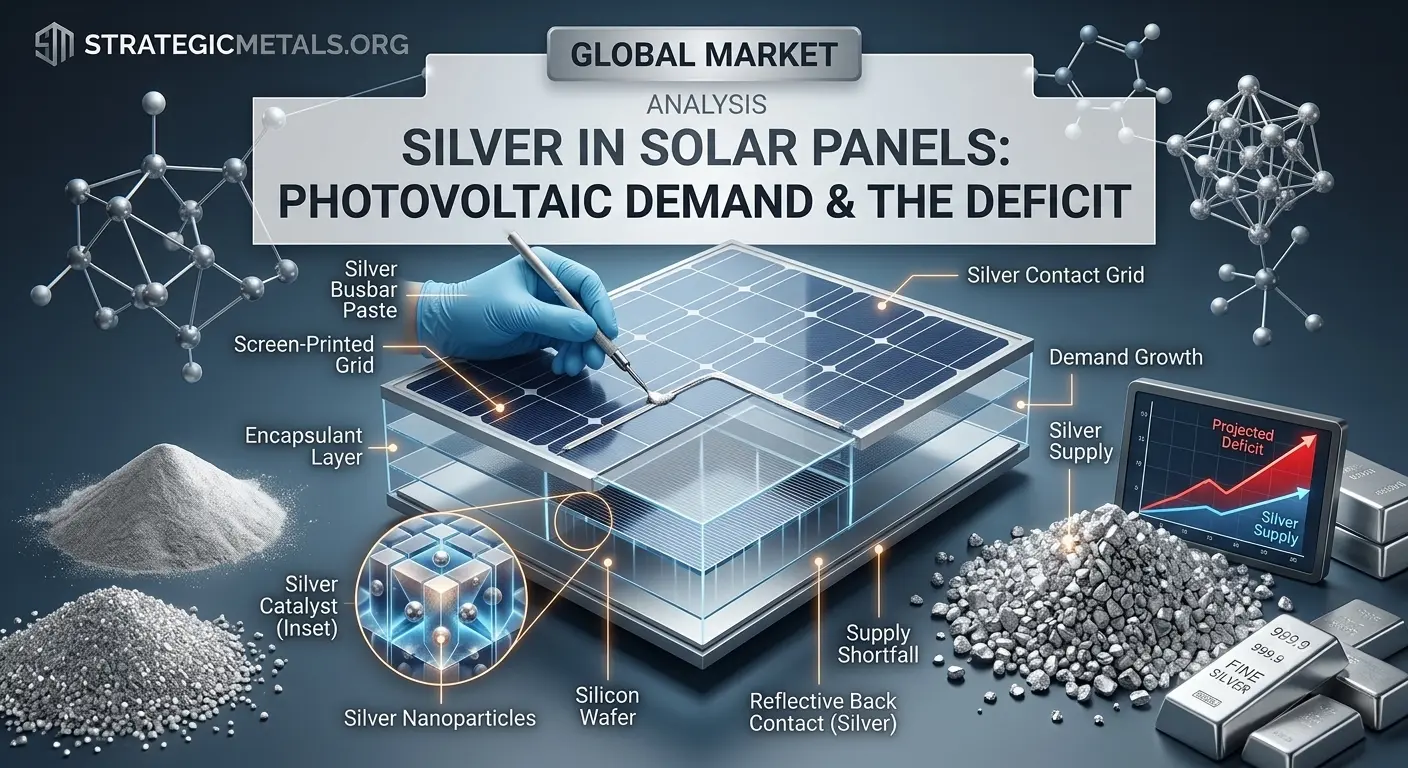
Silver gridlines collect the current that sunlight generates in the silicon and funnel it to the cell’s edge. When photons knock electrons loose in the wafer, those electrons must be gathered before they recombine and their energy is lost — so the surface is printed with ultra-fine “fingers” that catch the current and wider “busbars” that carry it off to the next cell. The pattern is laid down as a silver paste squeezed through a fine screen, then fired so it bonds to the silicon.
The engineering is a balance on a knife-edge: thinner, fewer lines shade less silicon and use less silver, but past a point their resistance climbs and efficiency falls. Silver’s conductivity is what gives designers room on that trade — it lets the lines get very fine before losses bite. Swap in a poorer conductor and the same line either has to be wider (shading more silicon) or accept more loss, which is the quiet penalty behind every gram of silver removed.
Silver Paste vs the Cheaper Metals Beneath It
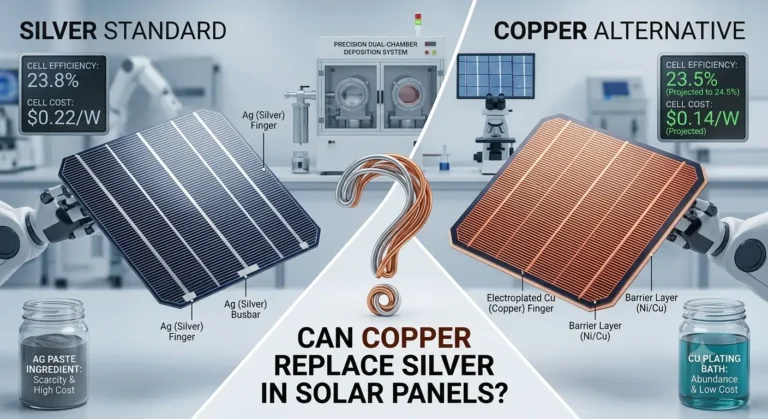
The alternatives to silver are cheaper, and each is a genuine downgrade on the properties that matter. Copper conducts about 94% as well as silver and costs a fraction as much, but it oxidizes readily and diffuses into silicon, where it poisons the cell — so it cannot simply be printed on; it must be electroplated over a barrier layer and capped to keep it from corroding, adding process steps and new failure points. Aluminum is abundant and cheap, and already forms the rear contact of older cells, but it is a far weaker conductor that cannot make the fine front-side lines a high-efficiency cell needs. The hierarchy is not an accident: silver sits on top because it is the best, copper is the cost-driven challenger with real caveats, and aluminum fills the roles where conductivity matters least.
How Much Silver Is in a Solar Panel
A typical modern solar panel contains roughly 5 to 15 grams of silver, depending on its wattage, cell type and age — older and higher-power panels sit toward the top of that range, newer thrifted designs toward the bottom. By mass it is almost nothing, around 0.03% of the panel, yet by value and by function it is one of the most important ingredients in the cell. Because silver is dosed so precisely, the industry tracks it per watt of capacity and per cell, where the differences between technologies show up clearly.
Silver Content per Solar Cell
An individual solar cell contains on the order of tens of milligrams of silver — recent mainstream cells run roughly 75 to 160 milligrams each, and the industry-average loading is now about 10 milligrams of silver per watt of capacity, according to ITRPV data. Both figures have fallen every year. Per-watt is the more useful measure because it strips out cell size and links silver content directly to power output — and it is the number the whole industry is pushing down, targeting below 5 milligrams per watt by 2027.
Silver Use by Cell Type — PERC, TOPCon, HJT & BC
Silver use varies by cell architecture, and the shift to higher-efficiency designs actually pushed silver-per-cell up before thrifting pulled it back. The older PERC cell used the least because it needed silver on only one face; the newer n-type cells — TOPCon and especially heterojunction (HJT) — need silver on both sides and use more. Back-contact cells rearrange the grid entirely. The table shows the rough per-watt loadings and why they differ.
| Cell type | Silver use (approx., per watt) | Why |
|---|---|---|
| PERC | Lowest | Silver front only; aluminum rear contact |
| TOPCon | ~10 mg/W | Silver on both faces; now the mainstream cell |
| Heterojunction (HJT) | ~12 mg/W (highest) | Both faces plus special low-temperature silver paste |
| Back-contact (xBC) | Varies | All contacts on the rear; the first target for copper plating |
PERC Silver Loading
PERC — passivated emitter and rear cell — carried the lowest silver loading because it used aluminum for the entire rear contact and needed silver only on the front. That is exactly why the move away from PERC raised silver intensity: as PERC fell below 20% of production, the n-type cells replacing it use silver on both faces. PERC set the baseline every newer cell is measured against.
TOPCon Silver Paste Requirements
TOPCon cells use around 10 milligrams of silver per watt and are now the mainstream technology at roughly 70–80% of production. They need silver on both sides because they are bifacial, generating power from front and rear, so the rear aluminum of a PERC cell gives way to silver. As the volume workhorse, TOPCon is the largest single consumer of solar silver, which makes even small per-watt reductions on it significant for total demand.
Heterojunction (HJT) Silver Intensity
Heterojunction cells are the most silver-intensive mainstream design, at roughly 12 milligrams per watt and historically higher. They carry the double-sided penalty plus one more: HJT’s amorphous-silicon layers are heat-sensitive, so they need special low-temperature silver pastes rather than ordinary fire-through ones. That makes HJT both the biggest silver user per cell and the first place the industry is testing copper — the cell where the cost incentive to escape silver is strongest, and where the reliability questions are therefore most consequential.
Back-Contact (BC) Cell Silver Use
Back-contact cells move all the electrical contacts to the rear, giving an unshaded front face for higher efficiency and a clean all-black look. With the metallization on one side and finely patterned, they are the natural first target for copper plating — which is why China’s LONGi has aimed its silver-free copper push at its back-contact line. Their silver use varies by design, but as the proving ground for copper, back-contact cells matter to the silver story out of proportion to their share.
Why Solar Uses Less Silver Every Year
Solar uses less silver every year because manufacturers are cutting the silver in each cell faster than they are adding cells — an effort the industry calls thrifting. The driver is not performance but price: with silver the single largest cost line in a module, every milligram removed defends a margin. So engineers make gridlines finer, add busbars, and switch to lower-silver pastes, and silver-per-watt falls year after year. That downward pressure has become strong enough to outrun even record growth in the number of panels — but it is worth being clear-eyed that this is cost-cutting on the industry’s most important conductor, not a technical advance.
One consequence is rarely said out loud: cost has made silver reduction the dominant research direction. Nearly every advance aims at using less silver rather than getting more out of it, so the benchmark metal is the one almost no one is working to push further — because pushing it would mean using more of it. Copper is being refined toward silver’s standard, while silver’s own standard sits frozen by price, not physics.
How Far Photovoltaic Silver Demand Has Dropped
Photovoltaic silver demand peaked around 197 million ounces in 2024 and has fallen since — down roughly 6% to 186.6 million ounces in 2025, and forecast to drop a further 19% in 2026, to about 151 million ounces, on Metals Focus data reported by pv-magazine — even though the world installed more solar in 2025 than ever. This is not a demand collapse; it is thrifting working faster than installation growth. For scale, PV silver demand was just ~82 million ounces in 2020, so the market doubled and is now easing off a peak the industry judged too expensive to sustain.
Silver Thrifting vs Substitution
Thrifting and substitution are two different escapes from silver’s cost. Thrifting means using less silver for the same job — finer lines, more busbars, better pastes — and it has been the dominant force so far. Substitution means replacing silver with another metal entirely, principally copper, and it is the larger long-term threat to silver demand but is only now reaching commercial scale. Both accelerate when silver prices spike, and both are one-way: manufacturers rarely add silver back once they have engineered it out. The price link was explicit in early 2026, when silver’s surge pushed China’s LONGi to accelerate its move to copper-metallized cells. What neither move changes is the physics — copper is still a downgrade on corrosion and contamination — which is why the next section matters. Whether copper can really take over that job is the subject of our companion piece, copper solar panels.
Multi-Busbar & Zero-Busbar Silver Reduction
The most effective silver-cutting tools are new grid geometry. Multi-busbar (MBB or SMBB) designs replace a few thick lines with sixteen or more fine ones, shortening the path current travels so each line carries less silver. Zero-busbar (0BB) goes further and removes the printed busbars altogether, connecting the fine gridlines directly to the wires that join cells — the lowest-silver front-side design in production, cutting silver a further 10–20% per Metals Focus. These are the genuine engineering wins, because they trim silver with little performance cost. The deeper cuts — toward 1–2 milligrams per watt — depend on copper and on ultra-fine printing that is still proving itself, which is where the trade-offs begin.
The Downsides of Thrifting & Substitution
The case for cutting silver is almost always framed as progress, but on a product meant to sit on a roof for thirty years it is better understood as a set of trade-offs. Reducing silver or replacing it with copper buys a lower factory cost by spending down reliability margin, proven lifespan and recyclability — and, as the cuts go deeper, the efficiency headroom silver’s conductivity buys. The savings and the risks land on different people. This is the part of the story the industry advertises least, and it is the reason “use the cheapest conductor you can get away with” is a riskier strategy for infrastructure than for a throwaway gadget.
The Saving Reaches the Factory, Not the Roof
The economics of thrifting are lopsided in a way that rarely gets said plainly. With silver near its 2026 highs, it has run up to 30% of the cost of a cell and about 16–17% of a module, so cutting it matters enormously to a cell manufacturer’s margin. But the module is only a fraction of a finished solar project: on NREL’s benchmarks the panel is about 13% of a rooftop system’s cost (the rest is inverters, wiring, racking, labor, permitting and overhead) and roughly 40% of a utility-scale system. Run the numbers and silver is only around 2% of an installed rooftop system and 6–7% of a utility plant. In other words, thrifting saves the factory a great deal and the person who owns the panels almost nothing — while that owner inherits whatever reliability and lifespan risk the cost-cutting introduces. That asymmetry is the heart of the false-economy concern.
Copper’s Extra Failure Points
Copper’s problem is not conductivity — it is chemistry, and it adds failure modes silver does not have. Copper oxidizes in air and diffuses into silicon, where it creates recombination centers that degrade the cell, so a copper contact has to be built as a stack: a nickel barrier to stop diffusion, the copper, and a cap to stop corrosion. Each layer is a new thing that can fail. A peer-reviewed NREL study of copper-plated cells under damp-heat testing found copper migrating both up through the capping layer and down into the silicon, with the cell’s fill factor dropping several percent, and warned of “unresolved questions on the long-term integrity of plated contact structures” — noting that barriers thinner than about 200 nanometers degraded. None of this means copper cannot work; it means copper carries reliability risks that decades of silver cells simply do not.
In fairness, the industry is attacking these problems and making real progress. Fraunhofer ISE reported in April 2026 a copper-electroplated TOPCon cell using one-tenth the silver at the same 24% efficiency as its all-silver reference, which passed standard IEC 61215 qualification testing — genuine evidence that low-silver metallization need not cost efficiency. The honest caveat is that this is a pilot line and IEC 61215 is an accelerated qualification test, not twenty-five years in the field. Even LONGi, moving copper into mass production, and Qcells, whose R&D lead has called copper on TOPCon “much more challenging,” acknowledge that reliability and long-term data remain the open questions.
Warranty, Insurance & the Bankability Gap
The reliability question is not academic — it shows up as money, through warranties, insurance and financing. Solar modules are sold with 25-to-30-year performance warranties, but as the testing lab PVEL points out, most operating solar projects are less than five years old, so no recently introduced metallization has actually proven a 25-year field life — it can only be inferred from accelerated tests. Lenders and insurers price that uncertainty. A module whose durability is unproven is less “bankable,” meaning it can command worse financing terms, higher insurance premiums, or larger warranty reserves — costs that can quietly swamp the few cents of silver saved per watt. A cheaper cell that raises the cost of capital on a 30-year asset is not obviously cheaper at all.
Thrifting, Lifespan & the Waste Problem
Durability is where the trade-off compounds, because a solar panel’s value is the energy it makes over its whole life. Modern silicon panels degrade slowly — a median of about 0.5% a year, per NREL’s analysis of more than 11,000 measurements — and premium panels are warranted tighter still, but that longevity is engineered in, not guaranteed; 1990s-vintage modules degraded closer to 2% a year. Anything that shortens life or raises degradation hits the number that actually matters, the cost per kilowatt-hour over decades, far harder than a cheaper module helps it. Cut the lifespan of a panel whose installation you have already paid for, and you have made the electricity more expensive, not less.
There is a waste dimension too. As the first big wave of panels retires, silver is the metal that makes recycling pay — Fraunhofer researchers note the silver in an old panel can be worth more than its glass, aluminum and silicon combined. Thrift the silver toward zero and add copper contamination, and each retiring panel is worth less to a recycler and harder to process, weakening the economic case to recover it rather than landfill it. For a technology sold on its environmental credentials, building cheaper, shorter-lived, less-recyclable hardware — the logic of a throwaway device rather than durable infrastructure — cuts against the whole point. It is the difference between putting copper or aluminum wiring in a house: the cheaper conductor can pass inspection and still be the thing you regret.
The Global Silver Deficit & Solar’s Role
Even as solar’s own silver demand eases, the global silver market has run a structural deficit for years, with total demand outstripping supply. Solar is a major reason the market got so tight, and remains one of the largest industrial pulls on the metal — so the two stories are linked but distinct: solar’s per-panel appetite is shrinking while the overall market stays short. That distinction is key to reading the silver market correctly.
Silver’s Structural Supply Shortfall
The silver market has recorded a deficit every year since 2021, and the Silver Institute expects 2026 to mark a sixth consecutive shortfall. Industrial demand hit a record 680.5 million ounces in 2024 — driven by solar, electronics, electric vehicles and grid investment — against mine supply of about 820 million ounces, with the balance met by drawing down above-ground stocks and recycling. The annual gap has narrowed as record prices pull in supply and curb price-sensitive buyers, but its persistence is what has underpinned silver’s strength.
Why the Deficit Persists Even as Solar Uses Less
The deficit persists even as solar thrifts because solar is only one of several fast-growing industrial buyers, and the others are still climbing. Electronics, electric vehicles and the electricity grid all draw on silver’s conductivity, and their combined growth has more than offset solar’s per-panel decline. Silver’s dual nature deepens the tightness: it is both an industrial metal and an investment asset, so when prices climb, investor buying of coins, bars and funds can pull still more metal off the market. Solar easing its grip relieves one source of pressure; it does not resolve a shortfall driven by the whole electrification economy at once.
Why Byproduct Mining Can’t Answer Higher Prices
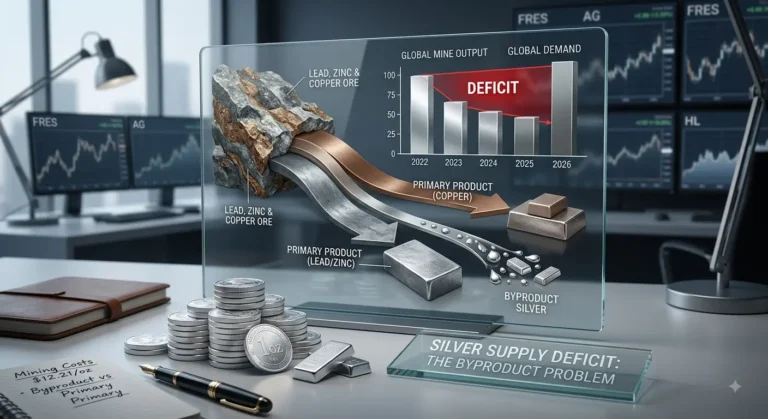
Silver supply cannot respond quickly to higher prices because most silver is never mined on purpose. Around 70% comes out of the ground as a byproduct of mining lead, zinc, copper and gold, so output is governed largely by demand for those other metals rather than by the silver price. A silver rally does little to bring on new supply when two-thirds of production is set by base-metal economics, and a dedicated primary silver mine can take a decade to open. That inelasticity is why an industrial demand shock can keep the market tight for years — and why the recycled silver in old panels is worth protecting rather than thrifting away.
What’s Driving Solar Demand — AI, EVs & Electrification
Solar’s silver demand ultimately rides on how fast the world builds solar, and that pace is set by a broad electrification of the economy after decades of flat power demand. In the United States, electricity use was roughly flat for two decades as efficiency offset growth, but the US Energy Information Administration now has demand rising again, led by data centers and a manufacturing revival. Solar is the main way that new demand is met, because it is the cheapest and fastest source of new generation — the installation side of the silver tug-of-war, and the reason silver demand could yet re-inflate.
Data Centres & the AI Power Boom
Data centres are the most talked-about new load. The IEA projects global data-centre electricity use to roughly double, from about 415 terawatt-hours in 2024 to around 945 by 2030, with AI the main driver. To power that around the clock, the four biggest tech firms signed nearly half of all corporate clean-power contracts in 2025, per BloombergNEF, increasingly as solar-plus-storage. It is worth keeping the scale honest — the IEA puts data centres at under 10% of global electricity-demand growth this decade — so they are a powerful accelerant rather than the single largest cause. The hardware is covered in metals in AI servers and the power question in nuclear power for data centres.
EVs, Heat Pumps & the Electrification of Everything
The larger, steadier driver is the electrification of transport, heat and industry. Electric-vehicle charging alone is set to more than quadruple its electricity use, from about 180 terawatt-hours in 2024 toward 780 by 2030 on IEA projections, with heat pumps and reshored manufacturing adding more. Each new load strengthens the case for building solar, increasingly paired with batteries so it can serve demand after sunset — which is why grid-storage growth, detailed in our guide to the future uses of lithium, moves in step with solar. More installed solar means more cells, and — until thrifting fully catches up — more silver.
Solar in Space — Why Satellites Are a Different Silver Story
Satellites run on solar too, but they are a different materials story that does not pull much on panel silver. Spacecraft use III-V multijunction cells on a germanium substrate, not silver-gridline silicon, because those cells reach around 30% efficiency and survive years of radiation — worth their high cost in orbit but not on a rooftop. Silver still rides along in satellite electronics, and the satellite boom is a real demand story for other strategic metals, but it is largely separate from the silicon-panel silver market. The space-cell metals sit closer to our guide to the future uses of gallium.
The Outlook — Solar Silver Demand Through 2050
The long-run question is whether the growth in solar installations overwhelms the savings from thrifting, or the reverse — and it is genuinely open, so the outlook is best read as competing scenarios, not a forecast. Layered on top is the quality question from earlier: if the industry keeps prioritizing the cheapest cell over the most durable one, silver demand falls but the fleet gets more fragile; if durability and reliability reassert themselves, silver stays. Both the quantity and the quality of future panels bear on where silver demand lands.
Installation Growth vs Silver Thrifting — the Tug-of-War
The two forces point in opposite directions. Annual solar installations are climbing toward and past a terawatt a year — the world built roughly 600 gigawatts in 2024, and SolarPower Europe projects around 1,000 gigawatts a year by 2029, with net-zero pathways implying more. Against that, silver intensity keeps falling, from about 60 milligrams per watt in 2010 to roughly 10 today, with the industry targeting below 5. Total solar silver demand is the product of those two curves, and for the past two years the falling-intensity curve has won. Whether it keeps winning depends on how far thrifting can go before the reliability and lifespan costs of the previous section start to bite.
Solar Silver Demand Scenarios to 2050
The table is an illustrative scenario, not a forecast: it multiplies a range of annual installation levels by two silver-intensity paths — one where the industry keeps cutting silver hard, one where silver holds closer to today’s level because durability and reliability win out. Both are legitimate. The gap between the columns is what the thrifting choice is worth to the silver market, and the last column shows the tension in the “silver holds” world.
| Year | Solar built that year | If the industry keeps cutting silver | If silver holds its ground | “Silver holds” share of world mined silver |
|---|---|---|---|---|
| ~2025 | ~600 GW | ~190 Moz (actual) | ~190 Moz | ~23% |
| ~2030 | ~1,000 GW | ~160 Moz (~5 mg/W) | ~300 Moz (~9–10 mg/W) | ~37% |
| ~2040 | ~1,300 GW | ~120 Moz (~3 mg/W) | ~400 Moz | ~49% |
| ~2050 | ~1,500 GW | ~95 Moz (~2 mg/W) | ~480 Moz | ~59% |
The two paths diverge enormously. Keep thrifting and solar’s silver demand plateaus or falls even as panels triple; let silver hold — because copper cannot prove its durability, or because the market shifts toward premium long-life panels — and solar alone would lay claim to a majority of all mined silver by mid-century, a genuine squeeze rather than a footnote. Installation figures span SolarPower Europe’s outlook and net-zero pathways from IRENA and BloombergNEF, the intensity paths follow ITRPV and Metals Focus, and silver is measured against roughly 820 million ounces of annual mine supply; independent academic work from Ghent University and Engie Laborelec similarly puts PV at 29–41% of global silver supply by 2030. Treat the numbers as directional illustrations of the tug-of-war, not predictions.
Why Durable Panels May Beat Cheap Ones
There is a reason the “silver holds” column may be more than wishful thinking: the economics that justify cheap, disposable panels weaken as the technology matures. Squeezing cost and accepting shorter life makes sense while efficiency is still climbing fast and you expect to replace panels with much better ones within fifteen years — longevity would be wasted. But single-junction silicon is now near its physical efficiency ceiling, and as the upgrade cycle slows, the calculus flips: if next year’s panel is barely better, you want the one on your roof to last forty or sixty years, and durability, reliability and low degradation become the prize. In that world, paying for silver — the metal that delivers exactly those properties — is the rational choice, not the wasteful one. The wildcard is whether perovskite-on-silicon tandems reignite the improvement race; if they do, cheap-and-replaceable logic persists a while longer, and if they stall, the case for durable, silver-rich panels gets stronger.
Will Solar Panels Stop Using Silver?
Solar panels are unlikely to stop using silver, and the reasons are as much about quality as cost. The bear case for silver is straightforward — thrifting continues, copper plating scales, and loadings fall toward 1–2 milligrams per watt. But the counter-case is equally real: every step away from silver is a downgrade on the properties that matter most for a thirty-year asset, copper’s field durability is still unproven, the cost saving barely reaches the panel’s owner, and a maturing industry has growing reason to value longevity over the cheapest possible cell. The honest answer is that silver’s role will shrink where copper can prove itself and hold where it cannot — and that the market may split, with commodity panels chasing the lowest silver content and premium, long-life panels keeping it. Which path dominates is not a settled technical fact; it is an open contest between cost and durability, and silver is the metal caught in the middle.
How to Track the Solar Silver Market
Following solar’s effect on the silver market means watching a handful of industrial indicators rather than a single price, because the story is a slow tug-of-war between installation growth, thrifting, and how the durability question resolves. The figures below describe what moves the market and how silver trades; they are context, not recommendations.
The Metrics That Move Solar Silver
The metrics worth watching pit the forces against each other. On the demand side: annual solar installations in gigawatts, the pace of silver thrifting in milligrams per watt, and the real-world reliability record of copper metallization as the first plated cells age in the field. On the supply side: the annual market deficit, above-ground stocks being drawn down, and mine and recycling output. The single most telling number is silver intensity — because it is falling fast, a stable installation forecast can still mean shrinking silver demand — but the durability data is the swing factor, because a single high-profile copper-reliability failure could stall substitution and put silver back.
How Silver Trades: Bullion, ETFs & Miners
Silver trades through several distinct vehicles, each described here purely as factual landscape. Physical bullion — coins and bars — is the most direct form, held by individuals and dealers worldwide. Physically-backed exchange-traded funds, such as the iShares Silver Trust (SLV) and Sprott Physical Silver Trust (PSLV) in the US market, hold allocated metal on investors’ behalf. Mining equities and miner-focused funds, like the Global X Silver Miners ETF (SIL), track producers — though most silver comes as a byproduct of base-metal and gold miners rather than pure-play silver companies, which complicates any “silver stock.” Futures and options on exchanges such as COMEX are used mainly by institutions and industrial buyers to hedge. Availability, tax treatment and costs vary by country, with the US shown here as the primary example. None of this is a recommendation; it is a description of how the market is structured, and any decision should follow your own research and a licensed professional’s advice.
A Short History of Silver in Solar
Silver has been in solar cells from the very beginning. When Bell Labs unveiled the first practical silicon solar cell in April 1954 — the work of Daryl Chapin, Calvin Fuller and Gerald Pearson, converting sunlight at about 6% efficiency — it needed metal contacts to carry the current out, and silver’s unmatched conductivity made it the natural choice. Those early cells powered the Vanguard 1 satellite in 1958 and proved the technology in space long before it was cheap enough for Earth.
As terrestrial solar grew, screen-printed silver paste became the standard way to metallize a cell, with the first commercial photovoltaic silver paste introduced in the early 1980s. For decades a cell might carry several hundred milligrams of silver and no one thought much about it. That changed only as solar scaled into a mass industry and silver’s price turned from a rounding error into the largest cost line in the module.
The modern era is defined by thrifting. From roughly 60 milligrams per watt in 2010, the industry has driven silver intensity down to about a sixth of that, through finer lines, more busbars, and pastes that stretch every milligram — and now through copper. It is a remarkable cost-engineering achievement, and an open question whether it is also a quiet erosion of the thing that made solar panels last: the best conductor humanity has, doing a job nothing else does quite as well.