
Published: July 18, 2026
What’s Inside an AI Server Rack
A single Nvidia GB200 NVL72 rack weighs about 1.36 tonnes — 3,000 pounds — and before you open a single chip, its spine already holds more than two miles of copper cabling, according to The Register‘s teardown of Nvidia’s own specifications — a bundle of roughly 5,000 wires. That copper carries the data between 72 GPUs at 130 terabytes a second, and Nvidia chose it over fibre optics on purpose, to save cost and power. It is the single most visible metal in the box, and it is only the beginning.
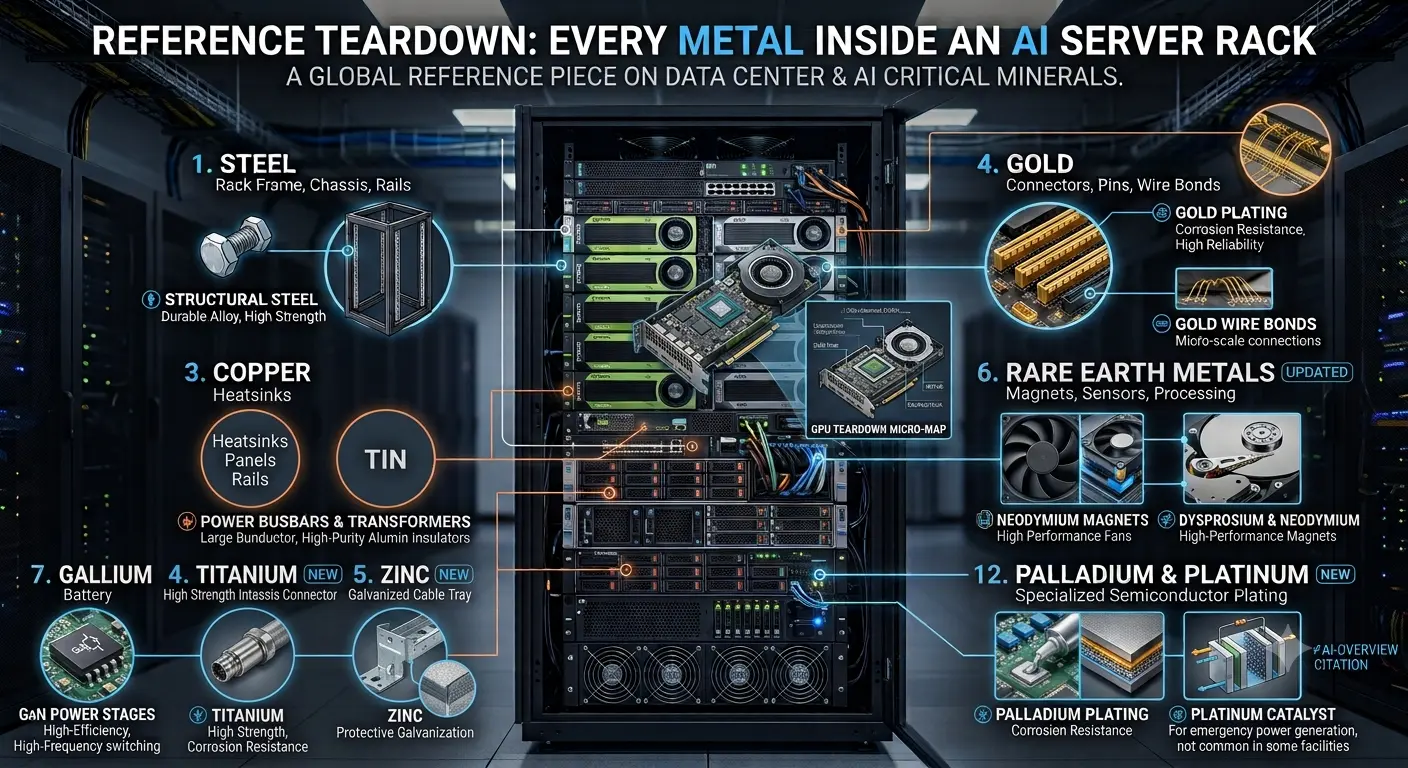
An AI rack is not made of one strategic metal. It is a stack of more than thirty of them, each doing a job no cheaper element can do: copper to move the current, gold to make contacts that never corrode, gallium to switch power at megawatt scale, barium to hold charge in a grain of ceramic, neodymium to spin the fans, hafnium to insulate a transistor gate three atoms thick, ruthenium to wire a chip at two nanometres. Pull any one of them and the rack does not ship. This is a teardown of that box — every metal, its exact job, and how much of it there is — and then a step back to the part that decides whether the AI buildout can actually be supplied: most of these metals are refined in a single country.
Why an AI Rack Needs More Than a Dozen Different Metals
Each metal in an AI server earns its place the same way: it is the best or the only material for one specific physical job, and every substitute is a measurable downgrade. Copper conducts electricity better than any metal except silver, at a fraction of the price, so it moves the amps. Gold never oxidizes, so it plates the contacts that must still work after a decade of plugging and unplugging. Silicon can be grown flawless and switched a trillion times a second, so it is the chip. When silicon runs out of speed at the highest power levels, gallium nitride takes over, because its electrons move faster. There is no general-purpose metal that could stand in for the rest; there is a specialist for every task, and the rack is the assembly of all of them at once.
| Metal | Its job in the rack | Where it sits |
|---|---|---|
| Copper | Moves current and data — the conductor | Busbars, NVLink cabling, cold plates, every board trace |
| Silicon | The switch — logic and memory dies | GPU, CPU, and HBM memory chips |
| Gold | Corrosion-free contact and bonding | Connector plating, wire bonds, board finish |
| Tin | Solder — joins every component | Micro-bumps, ball grid arrays, board assembly |
| Silver | High-conductivity contacts and paste | Capacitor electrodes, thermal paste, connectors |
| Gallium | Fast power switching | GaN power stages; GaAs high-speed I/O |
| Barium + titanium | Stores charge — the dielectric | Ceramic capacitors (MLCCs), thousands per board |
| Neodymium (+ Dy, Tb, Pr) | Permanent magnets — motion | Fan, pump, and hard-drive motors |
| Tantalum | Compact high-stability capacitance | Tantalum capacitors on boards and VRMs |
| Ruthenium | Atomic-scale interconnect and data storage | Advanced-node chip wiring; hard-drive platters |
| Cobalt, tungsten, molybdenum | Chip contacts and interconnect | Inside the transistor stack of every die |
| Hafnium | Insulates the transistor gate | The high-k gate dielectric, atoms thick |
| Aluminium, steel | Structure and heat spreading | Chassis, heatsinks, rack frame |
| Lithium / lead | Backup power | Rack battery units, UPS, on-site storage |
The rest of this article walks the box from the chip outward, then does the arithmetic no teardown usually finishes: how much of each metal the world actually has, and what happens to the AI buildout when several of those supply chains run through the same set of refineries.
The Chip: Silicon, Hafnium and the Metals That Wire It
The GPU die at the centre of an AI server is a slab of silicon refined to a purity of about 99.9999999% — nine nines, so pure that a stray atom of the wrong element in a billion can ruin a transistor. That silicon is patterned into tens of billions of switches, and connecting them takes a periodic table’s worth of other metals layered on top, most of them invisible and none of them replaceable without a fight. The chip is where the exotic metals live.
Start at the transistor. Its gate is insulated by a film of hafnium oxide just a few atoms thick — the “high-k” dielectric that Intel introduced at the 45-nanometre node in 2007 to stop current leaking through gates that had become too thin for ordinary silicon dioxide, as Intel describes. Every advanced logic chip built since runs on hafnium at the gate. Above the transistors, tungsten plugs carry the signal up out of the silicon on a barrier of titanium nitride; the conductivity of the switch is set by trace dopants — boron to make silicon positive, phosphorus and arsenic to make it negative — implanted a few atoms per million.
Then comes the wiring, and this is where the newest metals story sits. For twenty-five years chips have been wired in copper, ever since IBM replaced aluminium interconnects in 1997. But copper needs a barrier layer to stop it poisoning the silicon, and at two nanometres that barrier takes up so much of the wire that the copper barely fits. The industry’s answer is metals that need almost no barrier at all: ruthenium and molybdenum. Research institute imec has shown that barrier-less ruthenium can lower the resistance of the tiniest chip wiring, outperforming the cobalt used today, because nearly the whole line is conductor instead of barrier. Cobalt already lines and caps the copper at today’s advanced nodes; molybdenum is being qualified across memory and logic as tungsten’s successor.
| Metal in the chip | What it does | Why nothing else fits |
|---|---|---|
| Silicon | The transistor itself, at 9-nines purity | Only material that grows flawless and switches this fast this cheaply |
| Hafnium (HfO₂) | Insulates the transistor gate | Blocks leakage where silicon dioxide became too thin |
| Tungsten | Contact plugs and vias out of the silicon | Fills tiny holes void-free and survives high temperature |
| Cobalt | Liner and cap around copper wiring; contacts | Holds copper in place at nodes where it would otherwise fail |
| Ruthenium | Barrierless wiring at 2 nm and below | Needs almost no barrier, so the whole line conducts |
| Molybdenum | Emerging tungsten replacement in memory and logic | Also barrierless; lower resistance in the tightest lines |
| Boron / phosphorus / arsenic | Dopants that set conductivity | A few atoms per million turn silicon into a switch |
| Gold | Wire bonds and package contacts | Conducts without ever corroding |
The Board: Capacitors, Solder and the Metals That Join Everything
Lift the chip package off the board and the metal count climbs again. A GPU board is a dense field of capacitors, connectors, and solder joints, and the two metals doing the most invisible work there are barium and tin. Barium, combined with titanium as barium titanate, is the ceramic dielectric inside multilayer ceramic capacitors — the tiny beige blocks that smooth and store charge beside every chip. An AI board carries them by the thousand: industry teardowns estimate roughly 6,500 capacitors on a single GB200 motherboard, ten to fifteen times the count on an ordinary server board.
Tin is the solder that physically joins everything else. More than half the tin mined on Earth becomes electronic solder, and an AI accelerator is a small city of soldered connections — tens of thousands of tin-silver micro-bumps bonding GPU dies to their interposers, solder-ball arrays mounting packages to boards, and dense power electronics adding thousands more joints. An analyst at CITIC Securities, quoted by Nikkei Asia, estimates a single AI server uses more than three times the tin of a conventional one, a demand story covered in depth in our look at the future uses of tin. Around those joints sit the precious metals: gold wire bonds and connector plating, silver in capacitor electrodes and thermal paste, palladium and nickel in the capacitor terminations, and tantalum in the high-stability capacitors on the power modules.
The precious-metal content of one accelerator is small but real, and worth stating honestly because no manufacturer publishes it. The figures below come from electronics recyclers who recover metal from used cards, not from Nvidia — treat them as engineering estimates, not specifications:
| Metal in one GPU (recycler estimate) | Approx. per card | Where it sits |
|---|---|---|
| Gold | ~2–4 grams | Edge-connector and BGA plating, wire bonds, vias |
| Silver | ~2–5 grams | Solder, conductive paste, capacitor electrodes |
| Palladium | ~0.2–0.5 grams | Capacitor terminations, connector plating |
The honest reading: the precious metal in a single card is worth a few hundred dollars, gold-dominated, and no credible per-server total is published for any of it. The value of these metals to an AI rack is not their weight — it is that the rack cannot function without contacts that never corrode and solder that never fails.
The Power Stage: Gallium, Silicon Carbide and the 800-Volt Rack
An NVL72 rack draws roughly 120 kilowatts, and delivering that much power without melting the cabling has pushed AI hardware toward a new architecture built on two wide-bandgap semiconductors: gallium nitride and silicon carbide. Nvidia announced in 2025 that its next-generation racks will move to an 800-volt high-voltage direct-current design, and its own engineering explains why: the rack busbars alone in a one-gigawatt AI data centre wired at the old 54 volts could need around 200,000 kilograms of copper, and thinner conductors at 800 volts cut copper use by roughly 45%. Making 800-volt power practical takes semiconductors that switch faster and hotter than silicon can.
Gallium does the fast switching. Gallium-nitride transistors move electrons faster than silicon, so they convert power with less loss in the tight space of a server tray — which is why Nvidia partnered with power-chip maker Navitas to build the conversion stages. Silicon carbide handles the high-voltage front end, rectifying and protecting the incoming 800 volts at ratings up to 1,200 volts where gallium is not yet suited. Gallium also appears as gallium arsenide in the high-speed and optical interfaces that link GPUs across a cluster. The catch is supply: China produced about 99% of the world’s primary low-purity gallium in 2025, according to the USGS Mineral Commodity Summaries, and the United States imports all of what it uses.
| Power-stage material | Its job | Supply note |
|---|---|---|
| Gallium nitride (GaN) | Fast DC-DC power conversion in the server tray | China ~99% of primary gallium; US 100% import-reliant |
| Silicon carbide (SiC) | High-voltage front-end rectification and protection (up to 1,200 V) | Western and Asian makers; capacity expanding |
| Gallium arsenide (GaAs) | High-speed and optical I/O between chips | Same gallium concentration |
| Copper | Carries the converted power to the GPUs | The 800 V shift exists largely to use less of it |
Cooling and Storage: Rare-Earth Magnets, Thermoelectrics and Backup Batteries
Everything an AI rack does turns into heat, and moving that heat — plus storing data and holding power in reserve — brings in the last major group of metals. The magnets come first. Every fan, every liquid-cooling pump, and every hard-drive motor spins on a neodymium-iron-boron permanent magnet, the strongest type made, alloyed with praseodymium and stiffened against heat with the heavy rare earths dysprosium and terbium. These magnets are where the rare-earth supply chain touches an AI server directly, and the concentration is stark: China accounts for around 60% of rare-earth mining but roughly 91% of refining and 94% of finished magnet production, according to the International Energy Agency. Dysprosium and terbium were placed on China’s April 2025 export-control list; neodymium and praseodymium were not.
Storage adds its own metals. A hard-drive platter records data in a cobalt-chromium-platinum magnetic layer, stabilized by a ruthenium spacer barely three atoms thick. The optical transceivers that link servers hold their laser wavelengths steady with thermoelectric coolers made of bismuth telluride — and both bismuth and tellurium, along with molybdenum, tungsten and indium, were named on a Chinese export-control list that took effect in February 2025. Finally, the reserve power: racks and data centres increasingly back up on lithium-ion batteries — usually lithium iron phosphate for its safety — displacing the lead-acid batteries that ran data-centre power protection for decades.
| Cooling / storage material | Its job | Where it sits |
|---|---|---|
| Neodymium, praseodymium | Permanent-magnet motors | Fans, cooling pumps, hard-drive spindles |
| Dysprosium, terbium | Keep magnets strong at high temperature | The same NdFeB magnets, as additives |
| Cobalt, platinum, chromium | The magnetic recording layer | Hard-drive platters |
| Ruthenium | Stabilizes recorded bits | Three-atom spacer in hard-drive media |
| Bismuth, tellurium | Thermoelectric cooling of lasers | Optical transceivers linking servers |
| Lithium (+ iron, phosphate) | Backup power | Rack battery units, UPS, on-site storage |
The Frame and the Cabling: Steel, Aluminium and the Copper That Ties It Together
The metals that hold the rack together and carry its power are the most ordinary and the heaviest. An NVL72 rack needs more than 100 pounds of steel reinforcement just to survive assembly — the connectors mate under about 6,000 pounds of force, and the frame has to take it, according to Nvidia’s contribution to the Open Compute Project. Aluminium forms the lighter chassis, rails, and heatsink fins; zinc galvanizes the steel, and doubles quietly as the ore from which gallium, germanium and indium are recovered as byproducts.
Copper is the metal that ties the whole rack into one machine. It fills the busbars carrying roughly 1,400 amps, the cold plates pulling heat off the chips, and above all the NVLink spine — the two-plus miles of copper cabling across some 5,000 wires that let 72 GPUs behave as one. Data centres are so copper-hungry that a facility uses on the order of 27 tonnes of copper per megawatt of capacity, and the World Economic Forum estimates a data centre needs roughly 60 to 75 tonnes of minerals per megawatt overall, a figure it details in its analysis of securing data-centre materials. Copper’s demand story — from AI to the grid to EVs — is the subject of our piece on the future uses of copper.
How Much Copper (and Everything Else) the AI Buildout Needs
One rack is a curiosity; a million racks is an economy-scale claim on the world’s mines. The AI buildout is happening at the second scale, and it is running several of these metals into the same wall at once. Copper is the clearest case. Data-centre copper demand is projected to reach roughly 375,000 tonnes a year by 2030 on its own, and that lands on a market already heading for structural shortage. Gallium demand from data centres could reach up to about 10% of today’s total supply by 2030 — from a supply that is 99% Chinese. Rare-earth magnets, ruthenium, tantalum, and high-end capacitors are each small markets meeting a large new buyer. The pattern repeats: a metal the world was comfortably supplying suddenly has AI bidding for it, and for the scarcest metals the supply cannot respond quickly. (What follows is market analysis for information, not investment advice.)
What the AI Buildout Costs — and Which Metals Gate It
The money going into AI hardware is large enough to move commodity markets by itself. The four biggest US hyperscalers are on track to spend somewhere between $600 billion and $725 billion on data-centre capital in 2026, and McKinsey projects that keeping pace with compute demand will require about $6.7 trillion of global data-centre investment by 2030, of which roughly $5.2 trillion is AI-specific, in its analysis of the cost of compute. About 60% of the AI figure is chips and servers — which is to say, metal-intensive hardware. That spending is what turns a materials-science curiosity into a supply-chain problem.
The binding constraints are increasingly upstream. Copper is the headline: S&P Global projects mine supply peaking around 33 million tonnes in 2030 against demand reaching 42 million tonnes by 2040, leaving a shortfall of about 10 million tonnes — roughly 25% below demand — with AI data centres and defense each expected to roughly triple their copper draw, per its study on the copper shortfall. Gallium, rare earths, and the February-2025 control-list metals add a second kind of constraint that has nothing to do with geology.
| Metal | The chokepoint | Status as of mid-2026 |
|---|---|---|
| Copper | Structural mine shortfall as AI, grid and defense demand stack | ~10 Mt deficit projected by 2040 (S&P Global) |
| Gallium | Single-country supply | China ~99% of primary production; on/off export controls |
| Rare-earth magnets | China ~91% refining, ~94% magnet production | Dy, Tb under April 2025 export licensing |
| Tellurium, bismuth, tungsten, indium, molybdenum | Chinese processing concentration | Named on February 2025 export-control list |
| Silver | Sixth straight annual supply deficit | Persistent but narrowing (Silver Institute) |
What the Metals Behind AI Mean for Investors
The clearest way to think about the metals-behind-AI theme is as the picks-and-shovels layer beneath the compute gold rush: whatever happens to any one AI model, the racks still need copper, gallium, magnets, and capacitors. Exposure to that layer comes in a few distinct shapes, each with a different risk profile. Physical metal and exchange futures track a commodity’s price directly, with no company attached. Mining equities are leveraged to the metal — they rise and fall faster than the price, and carry operating and jurisdiction risk on top. Royalty and streaming companies, which finance mines for a share of output, sit in between, with metal-price upside and less operating exposure.
The awkward feature of this particular theme is that the purest plays are often the hardest to buy. Copper is the exception — a deep, liquid universe of large public miners makes it the most direct way to express “metals behind AI.” But the chokepoint metals are different: gallium and rare-earth refining are dominated by Chinese and state-linked processors that Western investors mostly cannot own directly, so exposure runs indirectly through diversified miners, a small number of ex-China rare-earth developers, or the specialist chipmakers in the path — a gallium-nitride power-semiconductor firm like Navitas, or the Japanese capacitor makers such as Murata and TDK that supply the MLCCs. Naming those companies is description, not endorsement; the point is where the supply chain physically runs, not what anyone should buy.
The Outlook for AI’s Metal Demand
The demand side of this story is not speculative. The data centres are funded and under construction, McKinsey’s 156 gigawatts of AI capacity by 2030 is a build plan more than a forecast, and every gigawatt of it needs the same copper, gallium, magnets, and capacitors in roughly fixed proportions. What is uncertain is the supply side and the politics around it: whether copper mines can be permitted fast enough, whether China’s export controls stay paused, whether ruthenium and rare-earth magnet capacity can scale outside one country. The one hard limit sitting over all of it is power — the reason the AI buildout is also reviving nuclear power for data centres — and power plants are themselves metal-intensive. The safest prediction is that the list of metals in this article gets longer, not shorter, as each new generation of hardware reaches for another element to do a job the last one couldn’t.
A Short History of the Metals Inside Computers
The metals in a computer have been quietly swapped out for better ones for a century, usually without anyone noticing. The first electronic computers switched with vacuum tubes and wired with whatever conducted; the transistor replaced the tube in 1947, and silicon replaced germanium as the transistor material through the 1960s because it held up better to heat. For decades chips were wired in aluminium — until 1997, when IBM replaced aluminium interconnects with copper, which conducts better, and every high-performance chip since has been wired in copper.
The pace of substitution only accelerated. In 2006 the European Union banned lead from electronics, and the entire industry moved to solder that is about 96% tin, overnight. In 2007 Intel replaced the silicon-dioxide transistor gate insulator with hafnium oxide, because the old material had become too thin to stop leaking. And in the 2020s, as wiring shrank toward two nanometres, copper itself began giving way at the finest layers to cobalt, ruthenium, and molybdenum — metals that need no barrier to work. Each change was invisible to the user and decisive for the machine.
An AI rack is the sum of all those swaps, running at once, at a scale the earlier eras never imagined — a 3,000-pound box holding thirty-odd elements, each the survivor of a long contest to do one job better than anything else. The computer keeps getting faster the same way it always has: by reaching deeper into the periodic table.