
Published: July 18, 2026
The Magnet Problem Standing Between Us and Fusion Power
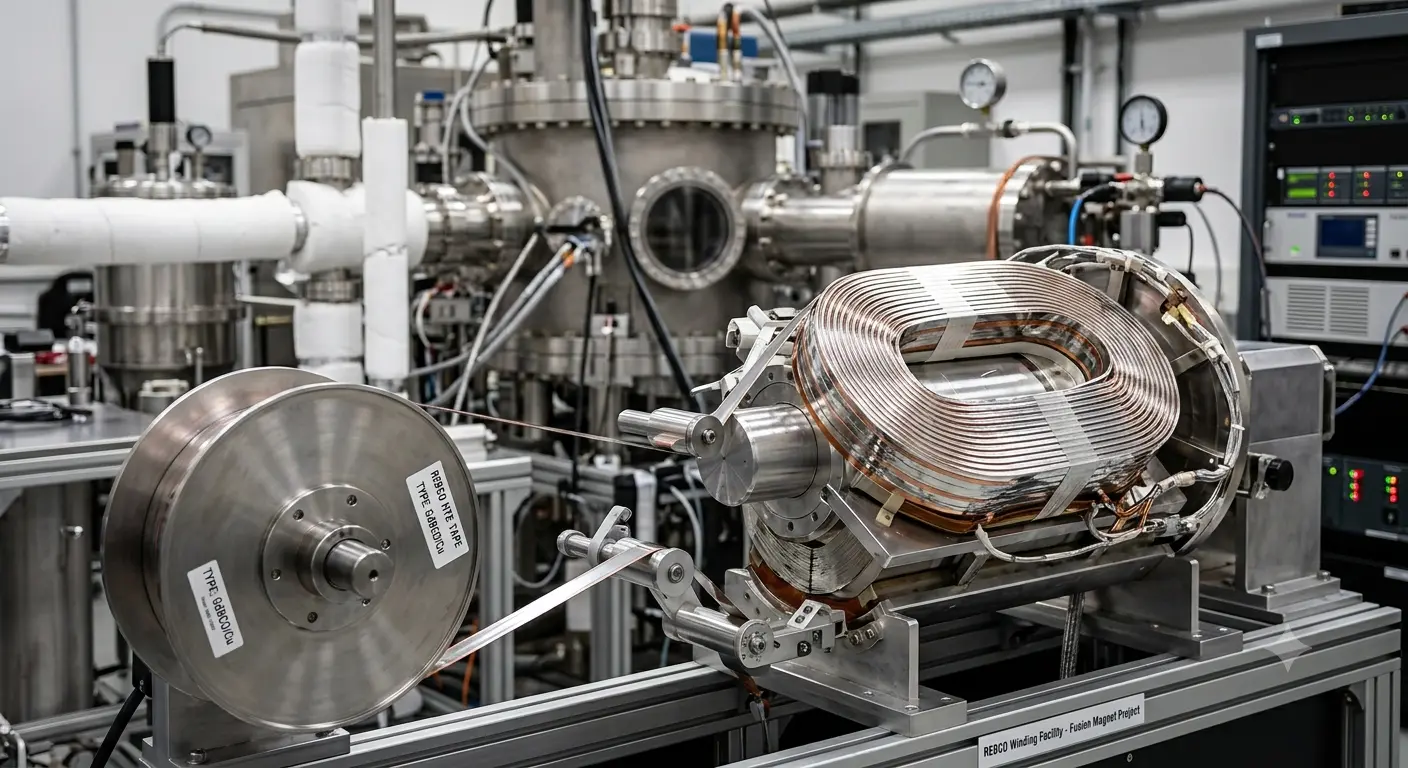
For seventy years fusion research has been stuck behind one stubborn fact: to hold a plasma hotter than the core of the Sun in place long enough to fuse, you need a magnetic field, and the stronger the field, the smaller and cheaper the machine can be. Conventional superconducting magnets topped out around 12 to 13 tesla, which is why the international ITER tokamak in France grew into a 23,000-tonne giant the size of a stadium. Then in September 2021 a magnet the size of a person did something no fusion-scale magnet had done before: it reached 20 tesla, and it did it with a ribbon of rare-earth ceramic tape.
That tape is REBCO — rare-earth barium copper oxide — a high-temperature superconductor grown just a couple of microns thick on a metal ribbon. It is the reason a serious group of physicists now believes commercial fusion could arrive in the 2030s rather than the 2060s, and the reason a single startup, Commonwealth Fusion Systems, has raised close to $3 billion to build a reactor around it in Devens, Massachusetts. This is the story of how a brittle ceramic almost nobody outside a materials lab has heard of became the component the entire compact-fusion bet is riding on — and where the money and the supply are choking behind it.
Why REBCO? The Rare-Earth Ceramic Nothing Else Can Match
Every magnetic-confinement fusion reactor lives or dies on how much magnetic field its coils can produce, and that ceiling is set by the superconductor inside them. The metals that carried fusion magnets for decades — niobium-titanium and niobium-tin — simply stop superconducting once the field around them climbs past a certain point, no matter how cold you make them. REBCO keeps carrying current in fields far beyond where those alloys quit, which is the single property that changes the game: it lets engineers build a much stronger magnet in the same physical space.
The comparison is stark when you line the materials up. Niobium-titanium, the workhorse of every hospital MRI, gives out below about 10 tesla. Niobium-tin, the alloy ITER chose for its main coils, reaches roughly 15 to 16 tesla but is brittle and has to be heat-treated into shape. REBCO tape has carried useful current in laboratory fields above 30 tesla, and it does so at temperatures around 20 kelvin rather than the 4 kelvin the niobium alloys demand — a difference that makes the cooling dramatically simpler and cheaper. Every alternative is a downgrade on the one axis fusion cares about most: peak field.
| Superconductor | Practical field ceiling | Operating temperature | Where it is used |
|---|---|---|---|
| Niobium-titanium (NbTi) | ~8–10 tesla | ~4 K (liquid helium) | MRI scanners, ITER’s lower-field coils; cheap and ductile |
| Niobium-tin (Nb₃Sn) | ~15–16 tesla | ~4 K (liquid helium) | ITER’s main coils, high-luminosity LHC; brittle, heat-treated |
| REBCO tape (HTS) | 20+ tesla in a magnet; 30+ in the lab | ~20 K, and up to 77 K at low field | Compact fusion magnets, high-field science; expensive tape |
That single advantage — more field in the same space — cascades into everything else about the reactor. Hold onto it, because the rest of the article is really the consequences of it: what the tape is made of, how a stronger field shrinks the machine, how many kilometres of the stuff a reactor swallows, and what all of that is worth.
What REBCO Actually Is: Rare-Earth Barium Copper Oxide, Layer by Layer
REBCO stands for rare-earth barium copper oxide, a family of ceramics with the recipe REBa₂Cu₃O₇, where “RE” is any of several rare-earth elements. The original and most famous version uses yttrium — yttrium barium copper oxide, or YBCO — the compound that made headlines in 1987 as the first material to superconduct above the boiling point of liquid nitrogen. For fusion tape, manufacturers increasingly swap in gadolinium (GdBCO), which handles high magnetic fields slightly better, but the working principle is identical: a rare-earth atom, barium, copper, and oxygen arranged in a crystal that carries electricity with zero resistance when cold.
The catch is that this ceramic is brittle and useless as a bare wire — you cannot spool a crystal. So REBCO is manufactured as a coated tape, a sandwich of maybe a dozen layers built up on a flexible ribbon of Hastelloy, a tough nickel steel. The superconducting REBCO film itself is only about 1 to 2 microns thick — a fiftieth of a human hair — grown on precisely aligned buffer layers so its crystal grains line up and the current flows cleanly. Over the top goes a thin coat of silver, and then a copper layer to carry the current safely if the superconductor ever warms up and quenches. The finished tape is about 0.1 millimetre thick and 4 to 12 millimetres wide, and the part that actually does the superconducting is a rounding error of its bulk.
| Layer | Material | Rough thickness | What it does |
|---|---|---|---|
| Substrate | Hastelloy (nickel steel) | ~50 microns | Mechanical backbone; takes the enormous magnetic forces |
| Buffer stack | Oxide films | under 1 micron | A crystal template that aligns the REBCO grains |
| Superconductor | REBCO (YBCO / GdBCO) | ~1–2 microns | The rare-earth ceramic that carries current with zero resistance |
| Cap | Silver | ~1–2 microns | Protects the ceramic and makes a low-resistance electrical contact |
| Stabilizer | Copper | ~20 microns each side | Carries the current safely if the tape quenches, preventing burnout |
Those last two layers are why this ceramic quietly ties back to the rest of the metals economy: every metre of REBCO tape is plated in silver and clad in copper, and the compound itself is a copper oxide. A fusion magnet is not just rare earths; it is rare earths, silver, and copper laminated together kilometre after kilometre.
How a 20-Tesla Magnet Shrinks a Fusion Reactor
The reason fusion engineers chase magnetic field so hard is that the payoff is not linear — it is ferocious. The fusion power you can wring out of a given volume of plasma rises with roughly the fourth power of the magnetic field. Double the field and, in principle, the same-sized machine produces about sixteen times the fusion power; or, run the other way, you can hold the power fixed and shrink the reactor dramatically. Going from ITER’s ~12-tesla coils to a 20-tesla REBCO magnet is exactly this trade, and it is what lets Commonwealth Fusion’s SPARC chase a similar fusion performance to ITER in a machine a fraction of the size — an approach Science described as a small reactor with powerful superconducting magnets.
That size collapse is where the cost collapse comes from. A smaller reactor means less steel, less concrete, less vacuum vessel, a smaller building, and a shorter path from design to construction. When the MIT team behind the magnet reported their results, the project’s founder Dennis Whyte put the effect bluntly: the demonstration changed the cost per watt of a fusion reactor by a factor of almost 40 in a single day. The physics of fusion did not change; the magnet did, and the magnet is downstream of the tape.
REBCO’s higher operating temperature stacks a second saving on top. Because the tape still superconducts at around 20 kelvin instead of 4 kelvin, the cryogenic system that keeps it cold can be far simpler and more forgiving — there is much more thermal margin before the magnet warms into trouble. It is the same reason the ultra-cold end of technology keeps coming back to clever cooling; the machines that chill qubits to a few thousandths of a kelvin lean on exotic coolants and cryogenics for the very same margin, just far colder.
The REBCO Magnets Inside SPARC and ARC
Commonwealth Fusion Systems is the company that turned the REBCO magnet from a physics result into an industrial program. Spun out of MIT’s Plasma Science and Fusion Center in 2018, CFS built the record 20-tesla model coil, and in March 2024 it published the full results across six peer-reviewed papers, the evidence that the magnet was not a one-off stunt but a repeatable, buildable technology. The company is now assembling SPARC, a tokamak in Devens, Massachusetts designed to be the first to produce more fusion energy than it consumes, with first plasma targeted around 2026 and net energy the year after.
The engineering choice that made the magnet practical was to leave the tape almost bare. In a conventional superconducting coil every turn is wrapped in insulation; CFS pioneered a “no-insulation” winding that relies on REBCO’s own conductivity to route current around any local fault, which simplified fabrication and freed up space for cooling and structure. The trade-off is that the whole coil behaves as one electrical body, a design its engineers spent years proving they could control — and it is part of why an IEEE profile memorably described the reactor as being held together with tape.
Beyond SPARC sits ARC, the commercial power plant CFS plans to build in Chesterfield County, Virginia, aiming for roughly 400 megawatts of electricity in the early 2030s. Its customers are already lining up in a way fusion has never seen: Google has signed an agreement to buy 200 megawatts from ARC, and the Italian energy major Eni has committed to a power deal for the first plant. Those are not research grants; they are commercial bets that REBCO magnets will work at scale.
How Much REBCO Tape Does a Fusion Reactor Need?
A compact tokamak is, in a real sense, a machine for spooling superconductor. Commonwealth Fusion’s demonstration magnet alone used around 300 kilometres of HTS tape, procured in under a year — and that was one model coil. A full SPARC-class reactor needs on the order of 10,000 kilometres of REBCO tape wound across its magnet set, enough to stretch a quarter of the way around the planet. That single figure is why the tape, not the physics, is now the bottleneck people worry about — and what follows is market analysis for information only, not investment advice.
The problem is that the world was not making REBCO tape at anything like that rate. Before fusion, the entire global market for coated-conductor tape was measured in a few thousand kilometres a year, split among a handful of specialist manufacturers. A single reactor consuming 10,000 kilometres means one plant can swallow more than a year of the entire planet’s historical output. That mismatch is precisely what has set off a scramble to build tape capacity, and it is the clearest place where the fusion story becomes a supply-chain story.
| If the world builds… | REBCO tape required (~10,000 km each) | What it would mean against today’s output |
|---|---|---|
| One SPARC-class reactor | ~10,000 km | More than a year of recent total global tape production, for one machine |
| Ten commercial plants | ~100,000 km | Requires tape output to multiply many times over within a decade |
| A global fusion fleet (100+) | 1,000,000+ km | A tape industry an order of magnitude larger than anything built to date |
These are order-of-magnitude figures — tape length per reactor depends on the design and on how much current each tape can carry, which is itself improving fast. But the direction is not in doubt, and neither is the response: a wave of investment in REBCO tape manufacturing that researchers now describe as a “compact-fusion-triggered” industry, with new production lines being built across the United States, Europe, and Asia specifically to feed fusion magnets.
What the Fusion Buildout Is Worth
Fusion has quietly become one of the best-funded frontiers in deep tech. Private investment in fusion companies reached $9.77 billion cumulatively by mid-2025, with $2.64 billion flowing in during the prior twelve months alone — a 178% jump — across 53 companies, according to the Fusion Industry Association’s 2025 report. A large share of that capital is riding on magnetic confinement, and magnetic confinement, at the compact end, is riding on REBCO. This is the demand-and-money layer that makes the whole rare-earth-tape story matter beyond the physics.
Commonwealth Fusion is the clearest proxy for the REBCO bet. The company has raised close to $3 billion in total, including a $863 million round in August 2025 on top of an earlier $1.8 billion, and it has turned that into signed power agreements with Google and Eni. CFS is privately held and not something a public-market investor can buy directly, which is worth stating plainly: much of the purest exposure to this technology sits inside venture portfolios, not on a stock exchange. This piece has no financial relationship with any company named here.
The more durable investment lens is the “picks and shovels” one: whoever the winning reactor company turns out to be, a compact tokamak needs thousands of kilometres of coated conductor. That has drawn capital into the REBCO tape supply chain itself — established makers such as Japan’s Fujikura and Furukawa (SuperPower), Russia’s SuperOx, and China’s Shanghai Superconductor, alongside newer Western entrants and CFS’s own in-house production. The United States has set a target of building tape capacity above 10,000 kilometres a year to support the sector. And underneath the tape sit the raw inputs: the rare earths yttrium and gadolinium, plus the silver and copper in every laminate — the same critical-mineral supply chains, and the same concentration in a few countries, that shadow the wider rare-earth economy.
What REBCO Means for Fusion Investors
The investment logic of REBCO comes down to a single word: chokepoint. A compact tokamak has no substitute for high-field superconducting tape, so whoever secures REBCO supply sits on the narrowest part of the whole fusion value chain. That is why the sharpest exposure may lie less with the reactor builders than with the layer beneath them — the tape manufacturers and the rare-earth, silver, and copper suppliers feeding them — where scarcity, long lead times, and years-long qualification cycles hand incumbents real pricing power if fusion demand arrives on schedule. Fusion energy investment, superconductor supply chain, and rare-earth demand are all really bets on that one narrow layer.
The catch for a public-market investor is access. The purest REBCO bet, Commonwealth Fusion, is privately held, and the listed ways to play the theme — diversified superconductor, rare-earth, and industrial names with only a slice of their business in fusion — are indirect at best. The whole thesis is also gated on one event: SPARC actually proving net fusion energy near 2027. If that slips, or a cheaper competing conductor emerges, both the timeline and the economics move. The upside case is a genuinely new power industry; the risk is a decade of expensive tape chasing a market that has not switched on yet.
The Outlook for REBCO and Compact Fusion
The next few years will test whether the REBCO bet pays off, and the milestones are unusually concrete for fusion. SPARC is meant to reach first plasma and then, for the first time in a privately built tokamak, produce more fusion energy than it consumes — the result that would validate the entire high-field approach. In parallel, the tape industry has to prove it can scale: more kilometres per year, higher current per tape, and lower cost per metre, all at once. If both curves bend the right way, the rare-earth ceramic that hit 20 tesla in 2021 becomes the foundation of a new power industry; if the tape stays scarce and expensive, it becomes the ceiling. The likely reality is a demanding decade in which magnet performance keeps improving while supply races to keep up, and REBCO stays exactly what it is today — the component that decides how fast fusion can be built. The material that spent forty years as a laboratory marvel is now on the critical path of the energy transition, and it will stay there until either the reactors switch on or a better tape replaces it.
A Short History of High-Temperature Superconductors
For seventy-five years, superconductivity was a liquid-helium affair. Everything that carried current without resistance had to be chilled to within a few degrees of absolute zero, which kept the phenomenon locked in physics labs. Then in 1986, two IBM researchers in Zurich, Georg Bednorz and Alex Müller, found superconductivity in a lanthanum barium copper oxide at about 35 kelvin — far warmer than anyone thought a superconductor could be, and warm enough to break a barrier physicists had assumed was fixed. The result was so startling it earned them the Nobel Prize in Physics the very next year, the shortest gap between discovery and prize the award has ever seen.
The floodgates opened in early 1987. A group led by Paul Chu swapped lanthanum for yttrium and hit roughly 92 kelvin — above the boiling point of liquid nitrogen, a cheap and abundant coolant. Yttrium barium copper oxide, YBCO, meant superconductivity could finally leave the helium bath, and the March 1987 physics meeting where the results were unveiled became known as the “Woodstock of Physics.” The dream of the moment was power lines and levitating trains, and for decades the brittle ceramics mostly disappointed — too hard to turn into usable wire.
The payoff came from an application nobody in 1987 was thinking about. Once manufacturers learned to grow REBCO as a thin film on flexible metal tape, its real superpower turned out not to be the warm operating temperature but its refusal to quit in enormous magnetic fields. That property, not levitation, is what put it inside a fusion magnet. A discovery that promised to revolutionize the power grid instead spent thirty-five years becoming the one thing that might finally make a star in a bottle worth building.
REBCO Superconductors and Fusion FAQ
What does REBCO stand for?
Why are REBCO superconductors important for fusion?
What magnets does Commonwealth Fusion Systems use?
How strong is a REBCO fusion magnet?
What is the difference between REBCO and low-temperature superconductors?
What is REBCO tape made of?
Which rare earths are used in REBCO?
How much REBCO tape does a fusion reactor need?
Why does a stronger magnetic field make a fusion reactor smaller?
What temperature do REBCO fusion magnets operate at?
What is SPARC?
What is the difference between SPARC and ARC?
Is REBCO tape expensive?
Who makes REBCO superconducting tape?
Why is REBCO called a high-temperature superconductor?
How much has been invested in fusion energy?
Can you invest in Commonwealth Fusion Systems?
What is the no-insulation magnet design?
When will fusion power be commercially available?
Does REBCO use the same rare earths as magnets in motors?
What could replace REBCO in fusion magnets?
Related Articles