
Published: July 19, 2026
The Metals a Humanoid Robot Actually Runs On
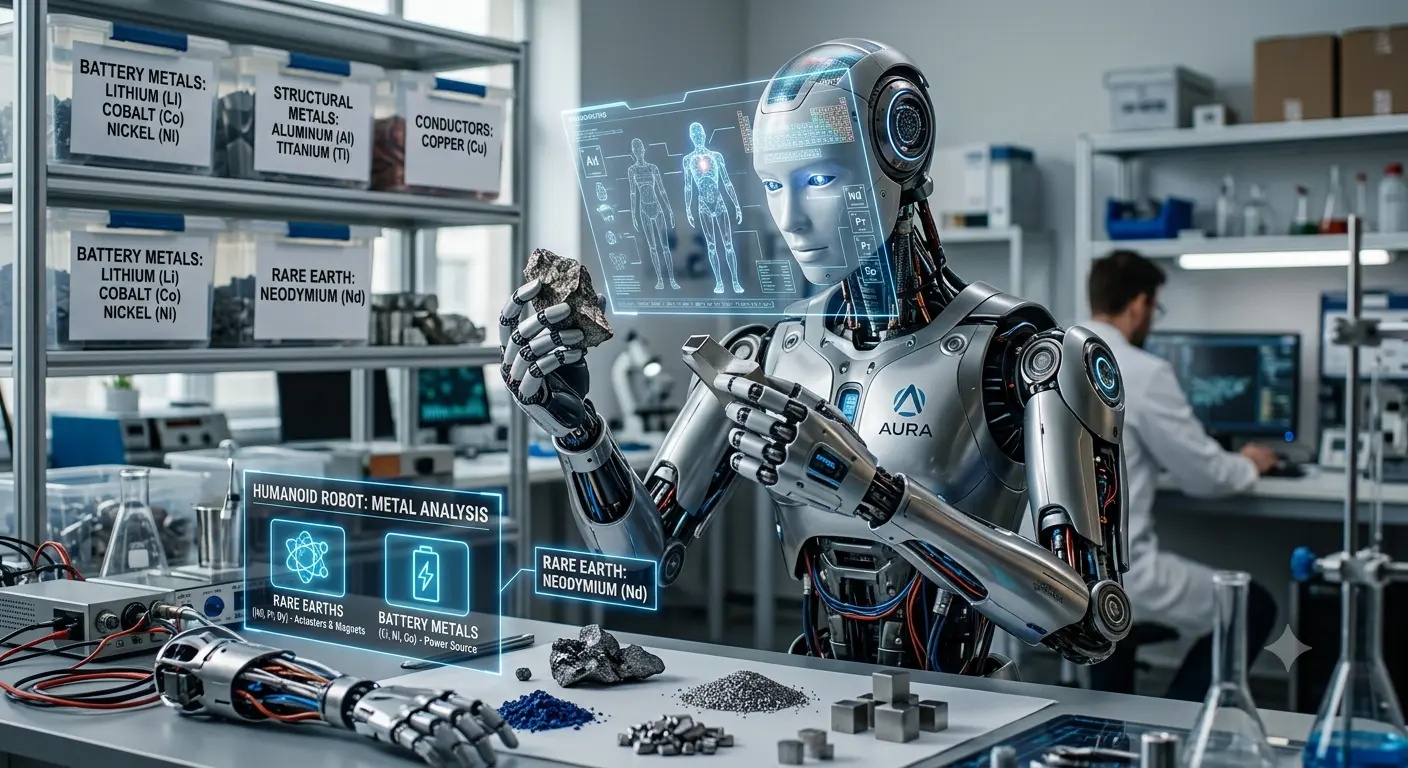
Strip a humanoid robot down to what makes it move and you find the same part repeated more than forty times: a small, powerful electric motor. Tesla’s Optimus carries on the order of 40 actuators and motors once you count its two hands; the human body it copies has closer to 80 movable joints, so the number only climbs from here. Almost every one of those motors turns on a magnet, and the best magnet for the job is made from a rare earth. Add it up and a single 60-kilogram humanoid holds roughly 3.5 kilograms of high-performance rare-earth magnet — about twice what sits in an electric car — wrapped in copper windings, wired with copper and silver, and standing on a frame of steel, aluminium, and titanium.
The headlines are about artificial intelligence and dexterous hands, but a humanoid is, at the level of physics, a rare-earth demand story wearing a sci-fi costume — and the magnets it depends on come almost entirely from one country. When Elon Musk said in April 2025 that Optimus production had been held up by China’s rare-earth restrictions, he was admitting that the bottleneck on the robot revolution is not code or chips but a lump of neodymium the size of a matchbox. This is what a humanoid robot is made of, how much of each metal it needs, and why the supply of the most important one runs through Beijing.
Why Neodymium Magnets? The One Material a Robot Joint Can’t Do Without
A robot joint has to deliver a lot of torque from a small, light package, and that requirement points at exactly one material: the neodymium magnet, known technically as neodymium-iron-boron (NdFeB), the strongest commercial magnet ever made. Torque in an electric motor scales with the strength of the magnetic field, so the stronger the magnet, the smaller and lighter the motor that produces a given force. In a humanoid that compounds: a lighter arm needs a smaller shoulder motor, which needs a smaller magnet, all the way down. Weaken the magnet and the whole machine gets heavier, slower, and hungrier for power.
Neodymium magnets win on a property called energy density — the amount of magnetic energy packed into a given volume — where they reach roughly 400 kilojoules per cubic metre, far beyond any alternative. Ferrite magnets, the cheap ceramic kind in fridge magnets and older motors, hold about a tenth as much, so a ferrite-driven joint would be roughly ten times bulkier for the same torque — a non-starter for a limb that has to fit a human form. Samarium-cobalt comes close on strength and tolerates heat better, but it is brittle and expensive, and its cobalt and samarium carry their own supply problems, so it survives only in aerospace and military niches, not on a mass-production line aiming for millions of units. The one weakness of the neodymium magnet is heat: it starts to lose its magnetism as temperature climbs, and a motor under load runs hot. The fix is to blend in a small amount of the heavy rare earths dysprosium or terbium, which hold the magnetism together past 120°C — a point that becomes important when we get to supply.
| Magnet type | Energy density (approx.) | Why a robot joint does or doesn’t use it |
|---|---|---|
| Neodymium-iron-boron (NdFeB) | ~400 kJ/m³ | The strongest commercial magnet — maximum torque in the smallest, lightest motor. The default for every high-performance actuator. |
| Samarium-cobalt (SmCo) | ~200 kJ/m³ | Handles heat better, but brittle, costly, and cobalt-dependent — used in aerospace and defence, not mass-market robots. |
| Ferrite (ceramic) | ~30 kJ/m³ | Cheap and abundant, but roughly ten times weaker — the joint would be far too big and heavy for a humanoid. |
| Induction / no permanent magnet | n/a | Avoids rare earths entirely, but lower torque density and efficiency — workable for some drives, a compromise for compact joints. |
That is the spine of the whole robot-metals story. The intelligence may be the miracle, but the movement runs on magnets, and the magnet has no equal. The rest of this article follows the metals into the machine — magnets first, then the copper, silver, and battery materials around them — and then out to the market and the supply chokepoint that decides how many robots actually get built.
Rare-Earth Magnets in the Motors: Neodymium, and a Little Dysprosium
The rare earths are where a humanoid robot’s material story really lives. Each of its 40-plus actuators — the rotary and linear motors that drive the shoulders, elbows, hips, knees, and fingers — contains a neodymium magnet, and the magnet is roughly a third rare earth by weight. So the 3.5 kilograms of magnet in a robot works out to somewhere around 1 kilogram of actual rare-earth elements per machine: mostly neodymium and its near-twin praseodymium, with a pinch of dysprosium or terbium for heat resistance. Those four elements are the ones that matter, and they behave very differently in the market.
Neodymium and praseodymium are the light rare earths — relatively more available and produced in larger volume. Dysprosium and terbium are heavy rare earths, far scarcer, more concentrated in Chinese and Myanmar deposits, and the ones caught most tightly in export controls. The conventional worry is that a billion robots will drain the heavy rare earths. The physics points to a subtler answer. A robot motor is small, runs in bursts rather than continuously, sits near room temperature, and can be actively cooled, so it does not need nearly as much dysprosium as an electric-vehicle traction motor or a wind turbine, which run hot for hours. The robot boom is therefore mostly a light rare-earth story — a surge in neodymium and praseodymium demand — that leans on the constrained heavy rare earths less, per unit, than the EV boom does.
| Rare earth in the magnet | Role in the motor | Supply note |
|---|---|---|
| Neodymium (Nd) | The core magnet element — provides the raw field strength | Light rare earth; the primary demand driver for robots |
| Praseodymium (Pr) | Substitutes for and blends with neodymium (sold together as NdPr) | Light rare earth; tracks neodymium closely |
| Dysprosium (Dy) | Preserves magnetism at high temperature (coercivity) | Heavy rare earth; scarce, China/Myanmar-concentrated, export-controlled |
| Terbium (Tb) | Same heat-resistance job as dysprosium, used in smaller amounts | Heavy rare earth; among the scarcest and most restricted |
The design connection to rare earths runs deeper than the motors, too. The same family of elements shows up wherever the site’s beat touches advanced technology — the yttrium and gadolinium in the superconducting tape inside fusion magnets, and the scramble to grow supply outside China that even has researchers testing whether plants can replace rare-earth mines. Robots are simply the largest new source of demand about to hit that same strained supply chain.
Copper in the Windings, Wiring and Battery
Copper is the second-largest metal story in a humanoid, and it hides in plain sight inside the same motors. Every actuator is wound with fine copper wire; push current through those windings and they create the magnetic field that spins against the permanent magnet. More motors means more windings, and a humanoid’s 40-plus actuators hold far more winding than a single large machine would. On top of that sits the wiring harness carrying power and signals from the battery to every limb, plus the copper in the battery’s own current collectors and the power electronics that manage it.
The per-robot figure is modest next to a car but adds up fast across a fleet. Industry estimates put roughly a kilogram or two of copper in a humanoid; at scale that becomes serious tonnage — one analysis reckons a billion robots would pull on the order of 1.6 million tonnes of copper a year, a few percent of today’s entire global copper demand, stacked on top of the pull already coming from data centres, grids, and electric vehicles. That is the same demand wave driving copper to record prices, and robots are a new claimant on it.
Silver in the Contacts, Sensors and Solder
Silver appears in a humanoid in small amounts but in places that matter, because it is the best electrical conductor of any metal and resists the corrosion that would slowly degrade a connection. It turns up in solder joints, in the plated contacts of connectors and relays, in motor terminals, and increasingly in the sensor layer — the touch, force, and temperature sensors a robot needs to handle the world without crushing it — where silver conductive inks and nanowires print the fine traces. None of these uses is heavy, but they are spread across hundreds of connection points in a single machine.
Exactly how much silver sits in a humanoid is not something manufacturers publish, so any figure is an engineering estimate rather than a spec sheet. One materials analysis put it at roughly 18 grams per robot — a useful order-of-magnitude marker, not a disclosed number, and one worth treating with caution until a teardown confirms it. Even at that level the fleet math is striking: a million robots a year would need on the order of 18 tonnes of silver, and the silver industry is already running a structural deficit, which is why robots feature in the demand outlook for the future uses of silver.
The Battery Metals: Lithium, Nickel, Cobalt and Graphite
A humanoid carries its own power supply, and that means a lithium-ion battery with the same materials that drive an electric car, just smaller. Tesla has described Optimus running on a roughly 2.3-kilowatt-hour pack — enough for around a day of light work — drawing on the order of 500 watts under real load. That battery is built from lithium, nickel, and cobalt in the cathode and graphite in the anode, the same four materials the whole electric-vehicle industry is already competing for.
Per robot the quantities are small, but the aggregate is where the analyst warnings concentrate. Adamas Intelligence, modelling a future fleet, found that the battery materials scale as steeply as the magnets: reaching billions of robots would demand many times today’s output of lithium, graphite, cobalt, and nickel, on top of everything the car and grid-storage markets already want. The robot is, in materials terms, a second electric-vehicle industry in a humanoid shell — a small battery, but multiplied by a projected population in the billions.
The Structural Metals: Steel, Aluminium and Titanium
The frame that all of this hangs on is mostly ordinary engineering metal, chosen for strength-to-weight. Aluminium alloys make up much of the structure and housings because they are light and easy to machine; steel handles the high-stress parts — gears, bearings, load-bearing joints — where hardness and fatigue resistance matter more than weight. Titanium appears where the very best strength-to-weight ratio is worth its cost, in select limbs and joints, though its expense keeps it a minority material in mass-market designs.
These metals are abundant and not supply-constrained in the way the magnets are, so they rarely make the headlines. But they set the robot’s weight, and weight feeds straight back into the magnet story: every extra kilogram of frame is a kilogram the motors must move, which argues for stronger magnets and larger actuators. The structural choices and the rare-earth bill are two ends of the same design equation.
How Much Rare Earth Would a Billion Robots Actually Need?
The per-robot numbers only become alarming when you multiply them by the fleet sizes the industry is forecasting. A humanoid needs about 1 kilogram of rare-earth elements in its magnets, so the demand depends entirely on how many get built — and the projections run from millions to billions. Set the per-robot figure against the world’s current rare-earth mine output of about 390,000 tonnes a year, per the USGS, and the scale of the coming claim on that supply becomes clear.
| If the world builds… | Rare earth needed (~1 kg each) | Share of ~390,000 t mined each year |
|---|---|---|
| 1 million robots/year | ~1,000 t | ~0.3% |
| 10 million robots/year | ~10,000 t | ~2.6% |
| 100 million robots/year | ~100,000 t | ~26% |
| 1 billion robots/year | ~1,000,000 t | ~2.6× total current output |
The table is a scenario, not a forecast — it assumes roughly 1 kilogram of rare earth per robot and holds today’s mine output flat, when in reality both would move. But it shows why analysts treat robots as a genuine demand shock rather than a rounding error. At a million units a year, robots barely register. At a hundred million, they would consume a quarter of all rare earth mined today. And the most-quoted long-range figure goes further still.
The Companies Building Humanoid Robots
The race to build a working humanoid splits along the same line the magnets do: American makers chasing scale against Chinese rivals who already sit inside the rare-earth supply chain. As of mid-2026 roughly half a dozen companies lead the field, and they have moved past trading demo videos — they are standing robots on real factory and warehouse floors.
| Company | Flagship robot | Where it stands (mid-2026) |
|---|---|---|
| Tesla (US) | Optimus (Gen 3) | Building a dedicated production line at Fremont; Elon Musk targets high volume but has publicly blamed China’s rare-earth magnet curbs for slowing the ramp. No commercial sales yet. |
| Figure AI (US) | Figure 03 | The best-funded pure-play, led by Brett Adcock; raised over $1 billion at a roughly $39 billion valuation, with commercial pilots underway. |
| Agility Robotics (US) | Digit | Furthest into real deployment — Digit already works in warehouses and logistics — and moving onto public markets via a listing valued around $2.5 billion. |
| Boston Dynamics (US / Korea) | Atlas (electric) | Now fully owned by Hyundai, which has committed tens of thousands of Atlas units to its own plants; first commercial robots slated to ship in 2026. |
| Unitree (China) | G1 / H1 | Undercutting everyone on price — the G1 starts near $16,000 — with high sales volumes and a filing for a multi-billion-dollar IPO. |
| Apptronik (US) | Apollo | Backed by Google and Mercedes-Benz at a roughly $5 billion valuation; Apollo is piloting inside Mercedes assembly plants. |
These are the names, and the founders and backers, that investors follow: Elon Musk at Tesla, Brett Adcock at Figure, Wang Xingxing at Unitree, and Google and Mercedes-Benz standing behind Apptronik’s $520 million funding round. Figure’s climb to a $39 billion valuation on more than $1 billion of fresh capital shows how hard money is chasing the category.
The Chinese contenders matter most to the metals story here. Beyond Unitree, a wave of Chinese makers — UBTech’s Walker S, Fourier, and Xiaomi’s CyberOne — is scaling fast, and every one of them builds where the magnets are made. A Western maker like Tesla waits on a Chinese export licence for the same neodymium magnets a Chinese rival buys at home, which turns the supply chokepoint into a competitive edge as much as a shortage. What every company here shares, wherever it is based, is dependence on that magnet supply — which is where the money question begins.
What the Humanoid Robot Buildout Is Worth — and Why Magnets Are the Gate
The money behind humanoid robots is large enough to make the metals question urgent. Goldman Sachs projects the humanoid market will reach about $38 billion by 2035, with shipments climbing from a few hundred thousand units a year at the end of this decade toward well over a million, as the cost of building a robot falls into the $30,000–150,000 range. Morgan Stanley’s longer-range work imagines a market measured in the trillions and a global fleet approaching a billion robots by 2050. Musk’s own target — 10 billion robots — sits far above any bank’s, but even the conservative forecasts imply a step-change in demand for the metals above. What follows is market analysis for information only, not investment advice.
The gate on all of it is the magnet, and the magnet runs through China. China mines about 69% of the world’s rare earths and dominates the harder step of turning them into finished magnets even more completely, producing roughly 90% of the world’s rare-earth permanent magnets, according to the IEA. It has shown it will use that position: in April 2025 it placed export controls on seven medium and heavy rare earths, the move that Musk blamed for slowing Optimus. On Tesla’s earnings call that month he said the company was “working through that with China” and hoped to “get a license to use the rare-earth magnets,” with Beijing wanting assurances they were “not used for military purposes, which obviously they’re not.” For a Western robot maker, securing magnets is not a purchasing detail — it is the single point where the entire production plan can stall.
That concentration turns the robotics thesis into a rare-earth supply-chain question. When rare-earth flows tightened through 2025, the price of neodymium-praseodymium oxide climbed sharply, and every robot maker outside China faced the same problem at once: you can design a brilliant machine, but if you cannot buy the magnets, you cannot ship it. The bottleneck also explains the intensity of Western efforts — from stockpiling to new mines to magnet factories — to build a rare-earth supply chain that does not depend on a competitor.
What the Robot Boom Means for Rare-Earth Investors
For an investor, the lesson of the metals bill is that the interesting exposure may not be the robot maker at all. The robots themselves are hard to own directly: as the makers above show, the leaders are either private (Figure, Apptronik, Unitree) or buried inside a much larger parent (Tesla, and Hyundai’s Boston Dynamics). The scarce, investable layer is the one every robot depends on and few can substitute: the rare-earth magnet supply chain. That is the pick-and-shovel position in the robot gold rush — and, unusually, the purest robot play is the one you can’t buy off a robot company at all.
| Exposure route | What it is | What to know |
|---|---|---|
| Ex-China rare-earth miners | MP Materials (US), Lynas (Australia) and peers | The main listed way to bet on rare-earth supply moving outside China; exposed to volatile prices Beijing can move at will |
| Magnet makers outside China | Emerging US, European, and Japanese NdFeB producers | The genuinely scarce step is finished magnets, not ore; a young, subsidy-dependent industry racing to scale |
| Robot makers (mostly indirect) | Tesla, Hyundai (Boston Dynamics), and actuator and component suppliers | The pure-plays profiled above are largely private, so listed exposure is indirect and diluted inside much larger companies |
| The other metals | Copper, silver, and battery-metal producers | Robots add incremental demand on top of EVs and data centres; a robot is one more claimant, not the main driver |
The risks are as specific as the opportunity. The fleet forecasts are speculative — a market that reaches billions of robots and one that stalls at a few hundred thousand imply wildly different metal demand, and no one knows which arrives. The light-versus-heavy rare-earth distinction matters here too: an investor betting on a dysprosium squeeze from robots may be leaning on the wrong element, since the robot pull is heaviest on neodymium and praseodymium. And rare-earth prices are hostage to Chinese policy in both directions — the same export lever that spikes them can, when loosened, undercut every Western producer built during the shortage. The supply chokepoint is real; the timing and the winners are not knowable in advance.
The Outlook for Humanoid Robots and the Metals They Need
The next few years will test whether the robot vision and the metal supply can move toward each other. On the demand side, the momentum is real: costs are falling faster than analysts expected, the first commercial deployments are underway in factories and warehouses, and every major forecaster now models a fleet in the millions within a decade. On the supply side, the response is slower. Western rare-earth mines and magnet plants are being funded and built, but finished-magnet capacity outside China remains small and years from scale, and the heavy rare earths that give magnets their heat resistance are the hardest part to source anywhere but China and Myanmar.
The most likely path is neither a clean escape from the chokepoint nor a hard stop for robots, but a managed tension: production that scales roughly as fast as non-Chinese magnet supply and Chinese export policy allow, with a political risk premium sitting permanently in the price of the key metals. The lesson of the metals bill is that the humanoid robot is not held back by intelligence — the software is arriving — but by the oldest constraint in industry, which is whether you can get enough of the right material. For now, the robot’s mind is running ahead of its magnets.
A Short History of the Rare-Earth Magnet
The magnet that makes humanoid robots possible is barely forty years old. Through the twentieth century the strongest magnets were samarium-cobalt, powerful but expensive and dependent on cobalt, whose supply was already a strategic worry. Engineers wanted something stronger and cheaper, and in 1982 two teams on opposite sides of the world found it almost simultaneously: General Motors, working on cheaper magnets for car motors, and Sumitomo Special Metals in Japan both developed the neodymium-iron-boron magnet, trading scarce cobalt for far more abundant iron and neodymium.
The result was the strongest permanent magnet ever made, and it rewrote what small electric motors could do. Hard-disk drives, cordless tools, earbuds, electric-vehicle motors, wind turbines — each became possible or better because a tiny neodymium magnet could deliver torque that once required something far bigger. The same leap is what lets a humanoid pack 40-plus capable motors into a human-sized frame.
Then geography closed in. China, sitting on large deposits and willing to do the dirty, low-margin work of refining and magnet-making, built a near-monopoly over the following decades — while Western producers, unable to match Chinese prices, largely exited. A magnet invented in an American car lab and a Japanese metals plant became, within a generation, something the West could barely make for itself — and now the robot age depends on it.