
Last updated: July 22, 2026
The Future Uses of Silver
Industry now burns through more silver every year than every mine on Earth pulls out of the ground. The Silver Institute expects 2026 to close with a sixth straight annual deficit, and the gap is being filled by draining vaults that took decades to fill. What makes that remarkable is where the metal is going: not into coins or cutlery, but into solar cells, electric-car inverters, data-centre switchgear, next-generation batteries, missile electronics, and the water systems keeping astronauts alive. Silver is quietly becoming one of the load-bearing metals of the technology economy, and the supply side cannot keep up.
The reason sits in the periodic table. On the three properties that matter most to electronics — how well a material carries current, how well it moves heat, and how well it bounces light — silver is not merely good. It is the best element that exists. Every engineer who designs silver out of a product to save money is accepting a downgrade; the only question in each case is how much downgrade the job can survive. That single trade-off explains everything below, from why solar makers are trying to escape silver to why a cruise missile can’t.
Why Silver? The Three Properties Nothing Else Beats
Silver’s technical value comes down to three superlatives, and in each case it sits at the very top of the entire periodic table — not near the top, at the top. Understanding what each property actually does inside a device is the difference between knowing silver is used and knowing why it can’t easily be swapped out.
Silver has an electrical conductivity of about 63 million siemens per metre, the highest of any metal and roughly 6% better than copper. That margin sounds trivial until it is multiplied across the billions of contact points in a solar array or the thousands of switching cycles in a fast charger, where a few percent less resistance means a few percent less waste heat and a longer service life. Silver also has the highest thermal conductivity of any metal, around 429 watts per metre-kelvin, which is why it turns up wherever heat has to be pulled away from a hot chip fast. And it reflects more than 95% of visible and infrared light — again the best of any metal — which is why it coats mirrors, spacecraft surfaces, and the back of many solar cells.
| Property | Silver’s rank | What it does in the device | What you lose by substituting |
|---|---|---|---|
| Electrical conductivity (~63 MS/m) | Highest of any metal | Carries current through solar-cell fingers, switch contacts, and printed circuits with the least resistance | Copper runs ~6% more resistive and corrodes; aluminium far worse — more heat, more loss |
| Thermal conductivity (~429 W/m·K) | Highest of any metal | Pulls heat off power chips in EV inverters and data-centre modules | Solder alloys conduct heat far worse and fatigue-crack under thermal cycling |
| Reflectivity (>95% vis/IR) | Highest of any metal | Reflects light back into solar cells and coats optical and spacecraft surfaces | Aluminium reflects less and tarnishes differently; efficiency drops |
| Antimicrobial action (silver ions) | Uniquely potent, low toxicity to humans | Kills bacteria in wound dressings, catheters, and spacecraft water | Chemical biocides degrade or need constant replenishment |
There is a fourth property that has nothing to do with electronics and everything to do with medicine: silver ions are lethal to bacteria at concentrations that barely register on human cells. That combination — deadly to microbes, gentle to us — is why silver keeps reappearing in hospitals and, increasingly, in the fight against drug-resistant infections. It is covered in full further down.
Silver in Solar Panels: Can Copper Really Replace It?
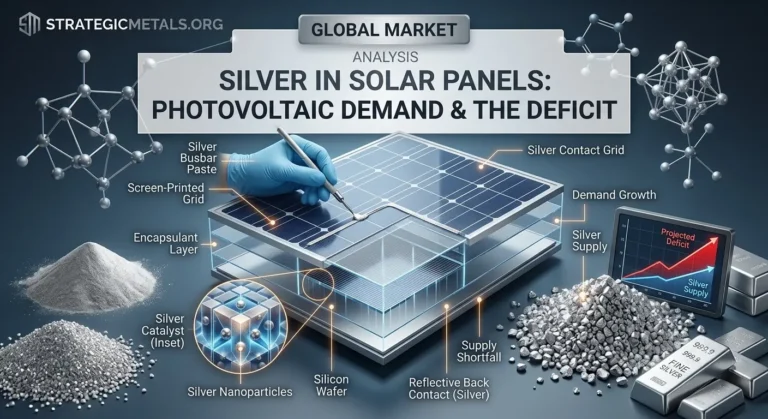
Solar is the loudest silver story because it is both the biggest new source of demand and the place the industry is fighting hardest to use less. A solar cell generates electricity in its silicon, but that current has to be collected off the cell’s face and carried away, and that job falls to a grid of ultra-fine conductive lines — the “fingers” — screen-printed in silver paste, feeding into wider collector strips called busbars. Silver is used here for one reason: its unmatched conductivity lets the fingers be thin enough to shade very little of the cell while still carrying the current out with minimal loss. Any other metal has to be either wider (shading more silicon) or more resistive (wasting more power).
How Much Silver Is in a Solar Panel
A standard TOPCon cell — the mainstream design in 2026 — uses roughly 10 to 12 milligrams of silver per watt of capacity, according to Fraunhofer ISE. On a typical panel that is a few grams, and across the hundreds of gigawatts the world installs each year it adds up to well over 150 million ounces annually — enough that photovoltaics grew from about 11% of industrial silver demand in 2014 to 29% by 2024. That scale is exactly why every milligram is under attack.
The reduction so far has come from “thrifting” — printing the fingers ever narrower and taller so they use less metal for the same conductivity. Finger widths have fallen from well over 100 microns a decade ago to roughly 30 microns in current production, with research pushing below 20. But this is where the balance bites:
How Copper Replaces Silver in Solar Cells
Copper is the obvious next move because it is the second-best conductor and costs a tiny fraction of silver. Instead of screen-printing silver paste, the leading approach electroplates metal directly onto the cell. Fraunhofer ISE has demonstrated cells that combine ultrashort-laser structuring with electroplated nickel, copper, and a trace of silver, cutting silver use roughly tenfold — down to about 1.1 milligrams per watt — while still reaching 24% efficiency. Heterojunction cells with copper metallization have come within a whisker of silver in the lab. On the spec sheet, the case looks strong.
The Cost of Switching Solar Cells to Copper
Copper carries three problems silver does not, and they only show up over time — which is exactly why the lab numbers flatter it. Copper atoms diffuse straight into silicon and poison the cell, so every copper cell needs an extra barrier layer, usually nickel, plated underneath to hold the copper back — a step silver never required. Copper also oxidizes, and it does so fastest under precisely the heat-and-humidity cycling a rooftop delivers day and night for decades, which means copper cells demand better sealing than silver cells ever did. And the plating process itself is capital-heavy and chemically messy, requiring precise patterning the cost-sensitive solar industry has struggled to run cheaply at gigawatt scale.
Then there is the problem no lab can shortcut: time. Silver-based panels carry 25-to-30-year warranties backed by decades of real-world field data in every climate. Copper-metallized panels have excellent lab data and only a few years outdoors. Nobody can honestly warranty three decades of performance for a construction that has not survived three decades outdoors — the long-term failure modes of copper under years of thermal and moisture cycling simply have not been observed yet at scale.
That uncertainty collides with how solar is actually paid for. On a residential system, the panel is a shrinking slice of the total cost — NREL’s cost tracking shows “soft costs” like labour, permitting, sales, and installation now make up the largest share of what a homeowner pays. The expensive part of going solar is not the panel; it is the crew, the truck, and the hours on the roof. A copper panel might shave a few dollars of silver off the hardware, but if it degrades faster and needs replacing years early, the homeowner eats the entire cost of a reinstall — labour and all. Saving a few dollars of silver to risk a several-thousand-dollar re-roofing job is a trade that makes sense on a manufacturer’s spreadsheet and none at all on a household’s.
Silver Sintering in EV & AI Power Electronics
The fastest-growing high-tech use of silver is one almost no one outside the industry has heard of: sintered silver die-attach. As electric-car inverters and AI-server power supplies switch to silicon-carbide chips, those chips run far hotter than the silicon they replace — hot enough that the traditional solder holding a chip to its baseplate fatigues, cracks, and fails after enough heating-and-cooling cycles. Silver solves it because a joint made of pure sintered silver conducts heat away far better than solder and keeps its integrity at temperatures that would destroy a soldered joint.
The process itself is where silver’s properties earn their place. Instead of melting a solder alloy, a paste of microscopic silver particles is pressed and heated below silver’s melting point until the particles fuse into a solid silver layer bonding the chip to the module. That layer has close to the thermal conductivity of bulk silver, so heat pours out of the chip instead of building up, and it survives the relentless thermal cycling of a car accelerating and braking or a data centre ramping under load. Copper sintering is being researched as a cheaper alternative, but silver remains the proven choice where the chip has to stay alive through years of hard cycling — the same “how much downgrade can this job tolerate” question, and for a traction inverter the answer is very little.
Silver in Data Centres & AI Hardware
The AI buildout is, underneath the software, an electricity problem — and every watt of it passes through hardware that leans on silver at several points. The scale is what makes a small amount of silver per component matter: data-centre IT power capacity has grown from under 1 gigawatt in 2000 to nearly 50 gigawatts by 2025, according to figures cited by the Silver Institute, and each new gigawatt is built from switchgear, servers, and power supplies that all use silver where reliability and conductivity are non-negotiable.
Start at the wall. The relays, contactors, and switchgear that route high-current power through a facility use silver-coated contacts because silver resists the tiny arc-erosion that pits and degrades lesser contacts every time they open and close under load. A contact that welds shut or burns away is a single point of failure in a building that cannot afford downtime, so silver plating buys reliability that is cheap next to the cost of an outage. Move inward and silver reappears in the server power supplies as sintered-silver joints under the hottest chips, then again in the conductive pastes, printed traces, and high-frequency connectors on the boards themselves, where its conductivity holds resistive losses and heat down at the densities AI hardware runs.
| Where silver sits in a data centre | Form | Why silver, specifically |
|---|---|---|
| Power distribution (relays, contactors, switchgear) | Plated contacts | Resists arc-erosion from repeated high-load switching; won’t weld or pit |
| Server power supplies (SiC power stages) | Sintered-silver die-attach | Conducts heat off hot chips and survives thermal cycling solder can’t |
| Circuit boards and modules | Conductive paste, printed traces | Lowest resistive loss at high signal density |
| High-frequency interconnects | Silver-plated connectors | Clean conduction with minimal signal loss and no corrosion |
None of these is a large amount of silver on its own — a plated contact here, a printed trace there. But multiply them across hundreds of thousands of servers and the power infrastructure feeding them, and the AI expansion becomes a genuine new claim on the same strained silver supply that solar and EVs are already pulling at. It is demand that barely existed a few years ago and is now compounding with the data-centre buildout itself.
Silver in Satellites: The Metal That Never Comes Back
Almost every other use of silver in this article is, in principle, recyclable — the metal in a dead phone or a scrapped inverter can be recovered, which is why recycling now supplies over 200 million ounces a year. Satellites break that loop completely. A low-Earth-orbit satellite is designed to deorbit and burn up in the atmosphere after roughly five years, and every gram of silver aboard vaporizes with it. With the mega-constellations now being built, that turns space into a one-way silver sink on a scale nothing else matches — a point investors tracking long-term silver demand have started to notice.
Silver is used in a satellite for the same three properties it earns everywhere else, just under harsher conditions. Its reflectivity makes silvered coatings the standard for thermal control, bouncing sunlight off surfaces to keep the spacecraft from cooking. Its conductivity puts silver gridlines and interconnects on the space-grade solar arrays that power the satellite — arrays that must squeeze maximum power from limited area, exactly where silver’s edge matters most. And silver-coated contacts, connectors, and RF components carry the power and signals through a machine that can never be repaired.
| Where silver sits in a satellite | Property used | Function |
|---|---|---|
| Thermal-control coatings | Reflectivity | Reflects sunlight to stop the spacecraft overheating |
| Space-grade solar arrays | Conductivity | Silver gridlines and interconnects collect power efficiently from limited panel area |
| RF and signal electronics | Conductivity | Carries radar, comms, and telemetry with minimal high-frequency loss |
| Contacts, connectors, wiring | Conductivity + corrosion resistance | Reliable power and control in a machine that can’t be serviced |
How Many Satellites Are Planned
The numbers are what make this a real demand story. SpaceX already operates nearly 11,000 Starlink satellites and has filed to build a 100,000-satellite next-generation constellation, alongside an even larger AI-focused “Starmind” megaconstellation ambition. China is racing to field its own constellations of tens of thousands. Because each satellite lasts only about five years, the whole fleet has to be manufactured, launched, and then thrown away and rebuilt on a rolling basis — a permanent replacement treadmill, not a one-time build.
How Much Silver Is in a Satellite
Manufacturers don’t publish silver content per satellite, so the table below is an illustrative estimate: it multiplies the yearly replacement rate by a plausible per-satellite silver figure to show the scale.
| Constellation scenario | Satellites built per year (~5-yr life) | Est. silver/yr (illustrative) | Share of ~800 Moz mined |
|---|---|---|---|
| Today’s fleet (~11,000, ~100 g/sat) | ~2,200 | ~0.2 t (~7,000 oz) | Under 0.01% |
| 100,000-satellite constellation (~100 g/sat) | ~20,000 | ~2 t (~64,000 oz) | ~0.01% |
| Million-satellite vision (~250 g/sat) | ~200,000 | ~50 t (~1.6 Moz) | ~0.2% |
The honest takeaway is not that satellites will dominate the silver market — even the million-satellite vision is a fraction of a percent of what the world mines. It is that this is the one major use where every ounce is permanently destroyed. Solar panels, phones, and inverters give their silver back through recycling, which now returns over 200 million ounces a year; a satellite that burns up on reentry returns nothing. As constellations scale toward direct-to-phone service and orbital compute, satellites become a small but relentless, recycling-proof drain on a market that increasingly depends on recycling to balance.
Why Future Satellites Will Use More Silver
The next generation of satellites is getting more silver-intensive, not less, because of what they are being built to do. Direct-to-phone constellations that connect ordinary handsets from space need bigger, more powerful arrays and denser signal electronics than simple relays. Earth-observation and defense satellites pack advanced radar and sensing. And the real frontier is compute: SpaceX and others are openly planning AI data centres in orbit — server farms in space powered by enormous solar arrays and cooled by radiating heat away — and researchers are developing quantum-communication satellites for un-hackable encryption. Every one of those directions means more solar array, more high-frequency electronics, and more of the silver that makes both work, on spacecraft that will still burn up when their time is done.
Silver in EVs & Charging Stations
An electric car is full of silver in small doses. Every relay and contactor that switches high-voltage power, every safety cutoff, and many of the connectors and sensor contacts throughout the vehicle rely on silver-coated points for the same reason a data centre does: they open and close under load thousands of times and must not degrade. The average car already contains silver in its electrical contacts, and an EV, with its high-voltage battery, power electronics, and dense sensor suite, uses considerably more than a conventional vehicle.
The charging network stacks demand on top. DC fast chargers switch very high currents, and the contactors and power modules that do the switching use silver contacts and, increasingly, sintered-silver joints to survive the heat and cycling. Behind the chargers sits the grid itself, whose switchgear and distribution equipment have used silver contacts for a century. Electrifying transport does not just put silver in cars — it puts it in every charger and every grid upgrade built to feed them.
Silver Batteries: From Your Watch to Your Car
Silver already runs a quiet empire in batteries, and it may be about to expand into the biggest battery market of all. The story runs up a ladder of increasing stakes — from the cheapest disposable cell to the power pack of an electric car — and at each rung silver is chosen for a property no cheaper metal fully replicates.
Silver-Oxide Batteries in Watches & Hearing Aids
The button cell in a quartz watch, a hearing aid, a car key fob, or a medical sensor is very often a silver-oxide battery. Silver oxide gives an exceptionally stable voltage for its whole life and packs a lot of energy into a tiny volume, which is why precision devices that need a flat, predictable output have used it for decades. Each cell holds only a sliver of silver, but they are made in enormous numbers, and together they represent a steady, unglamorous baseline of silver demand that has persisted through every shift in technology.
Silver-Zinc Batteries in Aerospace & Missiles
Move up the ladder and the stakes rise. Silver-zinc batteries deliver an unusually high burst of power for their weight and are extremely reliable, which is why they have long powered applications where a battery gets one chance to work: aerospace systems, submarine and torpedo power, and missile guidance. They cost far more than ordinary batteries, but in a device that must fire flawlessly the first and only time, the downgrade of a cheaper chemistry is unacceptable. This is silver being chosen purely for reliability, cost be damned.
How Much Silver Is in a Solid-State Battery
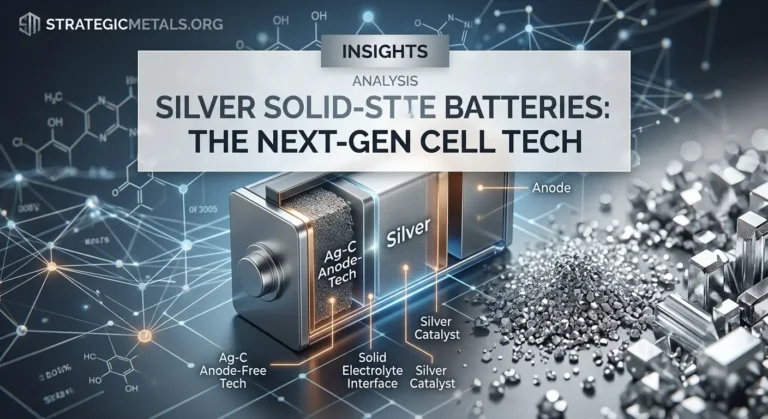
The rung that could reshape the entire silver market is electric-vehicle batteries. Samsung researchers published a solid-state battery design in the journal Nature Energy built around a thin silver-carbon composite layer — roughly 5 micrometres thick — that solves the dendrite problem which has long plagued solid-state cells. The silver-carbon layer lets the battery hit around 900 watt-hours per litre, support an estimated 800 kilometres of range, and last more than a thousand charge cycles. The silver in that layer is real and confirmed by Samsung’s own published work.
What Samsung has never published is how much silver each cell contains. That has been left to analysts, and their back-of-the-envelope figures are what make the silver market pay attention. Widely-cited estimates put it near 5 grams of silver per cell and roughly 1 kilogram per 100-kWh vehicle pack. Run that across a fraction of global car production and the numbers get dramatic: if solid-state cells of this kind reached 20% of the roughly 80 million vehicles built each year, one analyst estimate put the additional silver demand at around 16,000 tonnes annually — against total global mine production of only about 25,000 tonnes. Samsung has a production agreement with Toyota targeting mass production around 2027.
| Silver in batteries, up the ladder | Silver per unit | Why silver, specifically |
|---|---|---|
| Silver-oxide button cell (watches, hearing aids) | A sliver per cell, made in the billions | Flat, stable voltage and high energy density in a tiny volume |
| Silver-zinc (aerospace, torpedoes, missiles) | Substantial per unit, low volume | High power-to-weight and near-total reliability for one-shot use |
| Silver solid-state EV cell (Samsung/Toyota, ~2027) | ~5 g/cell, ~1 kg/pack (analyst estimate) | Silver-carbon layer blocks dendrites, raising density and cycle life |
The scenario table below shows why analysts treat solid-state batteries as the potential swing factor for silver — and why the estimated nature of the per-cell figure matters so much. The world mines roughly 25,000 tonnes of silver a year — about 800 million ounces — and that total barely grows year to year. Measured against that fixed pool, a single new application scales frighteningly fast.
| If silver solid-state EVs reach… | Est. annual silver demand (~1 kg/car) | Share of the ~25,000 t (800 Moz) mined each year |
|---|---|---|
| 10% of ~80M vehicles/year | ~8,000 t (~257 Moz) | ~32% of all silver mined |
| 25% of ~80M vehicles/year | ~20,000 t (~643 Moz) | ~80% of all silver mined |
| 50% of ~80M vehicles/year | ~40,000 t (~1,286 Moz) | More silver than the world mines today |
Silver in Humanoid Robots & Androids
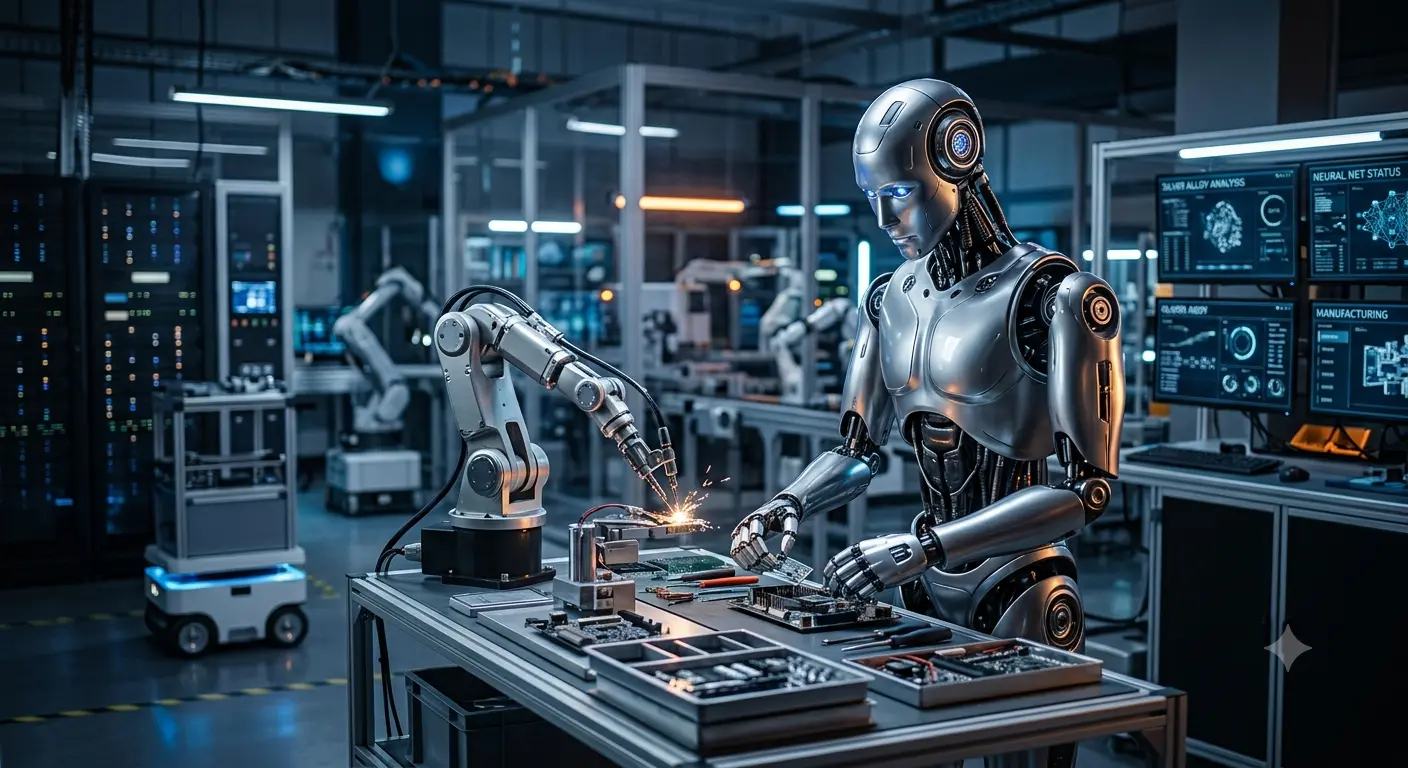
Humanoid robots are entering mass production right now, and they may become one of silver’s largest new sources of demand this decade. 2026 is widely called the first year of humanoid mass production: Tesla has converted a Fremont assembly line to build its Optimus robot with a designed capacity of up to a million units a year, ramping toward roughly a thousand a week by late 2026, while China’s Unitree — with unit prices down near $24,700 — has moved to volume production and a blockbuster public listing. Each of these machines is dense with exactly the electronics silver is best at.
A humanoid robot is, electrically, a concentrated bundle of nearly everything else in this article. It carries dozens of motors and their power electronics, hundreds of sensors, high-current battery and power-management circuitry, and AI compute boards — and silver appears at each of those points for its conductivity and reliability. Engineering estimates put the silver content of a sophisticated humanoid at roughly 10 to 20 grams, with about 15 grams a common working midpoint.
| Where silver sits in a humanoid robot | Form | Why silver, specifically |
|---|---|---|
| Joint motors & actuators | Power and signal contacts, relay contacts | Reliable switching across millions of movement cycles without contact wear |
| Force, tactile & position sensors | Silver contacts and conductive traces | Precise, low-loss signals for fine motor control and touch |
| Battery & power management | Silver-bearing solder, plated contacts | Handles high current with low loss and sheds heat |
| AI compute & comms boards | Conductive pastes, plated connectors, RF parts | Lowest-loss conduction at high signal density |
How Robot Mass Production Would Increase Silver Demand
The demand math is what makes robots a genuine silver story rather than a novelty, and unlike satellites the numbers get large fast. At about 15 grams each, the annual silver draw scales directly with how many robots the world builds. The scenarios below are illustrative — the per-robot figure is an engineering estimate, not a manufacturer disclosure — but they show why analysts watching silver treat humanoids as a potential swing factor alongside solar and batteries.
| If the world builds… | Est. silver/yr (~15 g each) | Share of ~800 Moz mined each year |
|---|---|---|
| 1 million robots/year | ~15 t (~0.5 Moz) | ~0.06% |
| 10 million robots/year | ~150 t (~4.8 Moz) | ~0.6% |
| 40 million robots/year | ~600 t (~19 Moz) | ~2.4% |
| 100 million robots/year | ~1,500 t (~48 Moz) | ~6% |
At a few million robots a year — plausible within a few years if Tesla, Unitree, and others hit their targets — humanoids would already rival mid-sized industrial silver uses. At tens of millions, they would compete directly with solar for the metal. The figures rest on that ~15-gram estimate, so treat them as scale, not certainty; if robots carry less silver, the totals shrink proportionally.
Why Defense Uses Silver in Missiles & Weapons
A myth circulates in precious-metals circles that a single Tomahawk cruise missile contains 500 ounces of silver — conveniently, exactly one full “monster box” of American Silver Eagles. The figure appears to trace back to online forum posts around 2011 with no verified source behind it, and the actual materials specifications for the BGM-109 Tomahawk are classified. Analysts who have estimated it from public data on aerospace silver use land far lower, in the range of 15 to 20 troy ounces per missile — less than a single tube of coins. The 500-ounce claim would mean silver alone made up over 1% of the entire missile’s weight, which is not credible.
The real reason defense uses silver is the same reason it uses silver everywhere else: on the properties that decide whether a system works, silver has no equal, and in a weapon that gets one chance, no downgrade is acceptable. The uses are specific and each answers a hard requirement.
| Silver in a missile or guided weapon | What it does | Why nothing cheaper works |
|---|---|---|
| Silver-zinc battery | Powers guidance and control from launch to impact | Highest power-to-weight of any practical chemistry, and utterly reliable for one-shot use after long storage |
| Silver brazing alloys | Join structural and electrical connections | Hold strength under extreme vibration, shock, and temperature swings |
| Silver-coated contacts and wiring | Carry guidance and control signals | A corroded or high-resistance junction could mean a miss; silver won’t corrode |
| RF and switching components | Handle radar, seeker, and telemetry signals | Highest conductivity keeps high-frequency losses lowest |
The silver-zinc battery is the heart of it. A missile can sit in storage for years and then must deliver full power the instant it launches, with no chance to recharge and no second attempt — the exact profile silver-zinc chemistry was built for. It costs far more than an ordinary battery, but in a one-shot weapon the cost of the silver is irrelevant next to the cost of failure. That single trade-off — reliability at any price — is why silver survives in defense long after it has been engineered out of consumer products.
Do Laser Weapons Change Silver Demand?
Defense is shifting real money toward directed-energy weapons — high-energy lasers that shoot down drones and missiles for a few dollars a shot instead of firing a million-dollar interceptor. A natural question follows: if the future of air defense is a reusable laser rather than an expendable missile, does that cut silver out of the picture?
The broader point is that silver’s role in defense tracks a requirement, not a product. As long as a system needs the most reliable battery, the lowest-loss conductor, or the joint that survives the most punishment, it reaches for silver — whether that system is a cruise missile today or a laser turret a decade from now.
Silver in Medicine & the Superbug Fight
Silver’s oldest use is turning into one of its most futuristic. Silver ions kill bacteria by attacking their cell membranes and internal machinery, and they do it at concentrations low enough to leave human cells largely unharmed — a selectivity most disinfectants can’t match. That is why silver dressings sit on burns and chronic wounds, why silver coats some catheters and implants to hold off infection, and why the metal keeps returning to hospitals despite a century of synthetic alternatives.
The frontier is antibiotic resistance. As bacteria evolve past the drugs meant to kill them, researchers are studying silver nanoparticles both as standalone antimicrobials and as a way to restore the punch of failing antibiotics — silver appears to weaken drug-resistant bacteria enough that older antibiotics work again. It is early-stage science with real hurdles, including the risk of bacteria developing silver resistance in turn, but against the slow-moving crisis of multidrug-resistant “superbugs,” a metal that attacks microbes through several mechanisms at once is a serious line of research.
Silver’s antimicrobial role even follows humans into space. NASA uses ionic silver as the biocide that keeps the drinking water safe aboard the International Space Station, and the Orion crew spacecraft was designed to use silver to disinfect its water system — chosen precisely because it keeps working passively without the constant replenishment a chemical biocide demands. On a mission where resupply is impossible, a biocide that simply stays in the water and keeps killing bacteria is worth its weight in, well, silver.
Is There Enough Silver for All These Industries?
Every section above describes an industry reaching for more silver — solar, AI hardware, satellites, EVs, batteries, robots, defense, medicine — and all of them are pulling on one finite, slow-growing supply. That collision is the question underneath the whole “silver shortage” debate: can the world actually mine enough silver to feed all of this at once? The next few sections lay out the arithmetic — first who actually digs the metal up, then how much each industry is projected to need, why supply can’t easily rise to meet it, and finally how investor demand tightens the squeeze further.
The Companies Mining the Most Silver
Nobody dominates silver mining — and the companies at the top of the list are mostly not silver companies at all, which is the supply problem in corporate form. The world’s largest primary silver miner, Fresnillo, produced 48.7 million ounces in 2025 — around 6% of world mine supply — and even that was 13.5% less than the year before, according to Fresnillo’s full-year 2025 results.
| Company | Where its silver comes from | Where it stands (dated) |
|---|---|---|
| Fresnillo (Mexico) | Primary silver & gold mines | 48.7 Moz attributable in 2025 (incl. Silverstream), down from 56.3 Moz in 2024 — the largest primary silver miner |
| KGHM (Poland) | Byproduct of copper mining | ~43 Moz from its Polish copper operations in 2024 |
| Newmont (Mexico) | Peñasquito, a gold-zinc-lead mine | ~33 Moz in 2024 — the largest single silver-producing mine |
| Hindustan Zinc (India) | Byproduct of zinc-lead mining | A record ~746 t (~24 Moz) in FY2023-24; the company calls itself the world’s third-largest producer |
| Pan American Silver (Americas) | Primary silver mines in five countries | 22.8 Moz attributable in 2025 |
| First Majestic (Mexico) | Primary silver mines | ~15.4 Moz in 2025, boosted by the Los Gatos acquisition |
Read down the middle column and the pattern is the article’s thesis in miniature: KGHM is a copper company, Peñasquito is run for its gold and zinc, and Hindustan Zinc is a zinc company — for all three, silver is a byproduct they collect on the way to something else, and none of them will dig faster because the silver price rises. The pure silver miners that could respond are the smaller half of the table, and the biggest of them produced less in 2025 than in 2024. That is the corporate face of the supply squeeze the sections below quantify.
How Much Silver Each Industry Will Need
The individual demand stories are striking on their own, but they land harder side by side — because they all draw on the same roughly 25,000 tonnes of silver mined each year. The table pulls the forward projections into one place. The green-technology totals are cumulative through 2030 from a Silver Institute–commissioned CRU study; the automotive figures come from the December 2025 Oxford Economics report the Institute published.
| Sector | Projected silver demand | Driver |
|---|---|---|
| Solar photovoltaics | ~820 Moz cumulative through 2030 | Record installs; already 29% of industrial demand, up from 11% in 2014 |
| Electric & new-energy vehicles | ~725 Moz through 2030; 25–50 g per EV | EVs overtake combustion cars for auto silver by 2027, ~59% of the market by 2031 |
| Green technology (all, combined) | 1.5+ billion oz through 2030 | Solar, vehicles, grid, and related electrification |
| Data centres & AI | Rising fast; not yet separately quantified | IT power capacity up from <1 GW (2000) to ~50 GW (2025) |
| Nuclear power | ~19 Moz through 2030 | Silver-indium-cadmium control rods; small but steady |
| Humanoid robots | ~15 g per robot; tens of Moz/yr at scale | Mass production beginning 2026 (Optimus, Unitree); scales with unit volume |
| Solid-state EV batteries | Potentially thousands of tonnes/yr (estimate) | Samsung-type silver-carbon cells if they reach scale (~2027+) |
The Silver Supply Squeeze
Set that rising demand against supply and the problem is clear. The World Silver Survey 2026 puts the market on course for a deficit of roughly 46 million ounces — the sixth consecutive year demand has outrun supply. Total supply is expected to reach about 1.05 billion ounces, with mine production near 820 million ounces and recycling climbing past 200 million ounces for the first time since 2012. None of that closes the gap, so the shortfall is covered by pulling silver bullion out of above-ground inventories.
Those inventories are visibly thinning. According to the World Silver Survey 2026, roughly 762 million ounces have been drawn from above-ground stocks since 2021 to cover six years of deficits. COMEX registered inventories had fallen to about 80 million ounces by mid-2026 — down more than 75% from their 2020 highs — while LBMA London vaults, at roughly 883 million ounces, sat about 20% below their January 2021 peak.
Metals Focus, the consultancy that prepares the survey for the Silver Institute, does not expect the pressure to lift quickly. “Lease rates in London have largely normalized, but risks of another liquidity squeeze this year remain,” Philip Newman, the firm’s managing director, said in April 2026 as the survey was published.
| 2026 silver market | Figure | Note |
|---|---|---|
| Market balance | ~46 Moz deficit | Sixth consecutive annual shortfall |
| Total supply | ~1.05 billion oz | Mine + recycling combined |
| Mine production | ~820 Moz | Up ~1%; most as byproduct |
| Above-ground drawdown since 2021 | ~762 Moz | Covering six years of deficits |
| COMEX inventories | ~80 Moz (mid-2026) | Down 75%+ from 2020 highs |
Why Silver Mining Can’t Simply Ramp Up
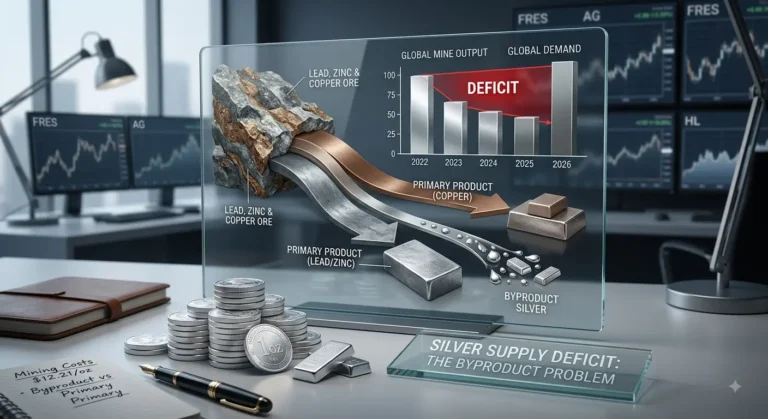
The intuitive answer to a shortage is to mine more silver, and the reason that barely happens is the single most important fact about silver supply: most of it is not mined on purpose. About 72% of silver comes out of the ground as a byproduct of mining other metals — lead-zinc operations alone account for nearly 30% of world supply, with copper and gold mines contributing much of the rest. Only around 28% comes from mines where silver is the main event. That structure quietly breaks the normal rule that higher prices bring more supply.
Consider a copper mine in Peru. Its entire operation — the ore body it chose, the equipment it bought, the mine plan it follows — is built around copper, and the silver that comes with it is a bonus that improves the economics. When the silver price doubles, that mine does not tear up its plan to chase silver, because its decisions are driven by copper. So the majority of silver supply is deaf to the silver price. Roughly 70% of the world’s silver simply cannot respond to a shortage the way an ordinary commodity would.
Why Even Primary Silver Miners Are Slow to Expand
That leaves the primary silver miners — the ~28% — to fill any gap, and they move cautiously for hard-learned reasons. A new mine is not a tap you open. Finding a deposit, drilling it out, proving the resource, permitting, financing, and building a mine takes a decade or more from discovery to first pour; a large copper-silver project can take up to three decades and billions of dollars. Nothing a miner decides today changes supply for years.
Even where they could push output, primary miners are wary of doing it by chasing lower-grade ore. Processing leaner rock costs more per ounce, and silver’s price is famously volatile — it can halve in months. A miner that expands into expensive, low-grade ore just as the price falls is a miner heading for bankruptcy, and the industry has watched that happen enough times to prize capital discipline over growth. Primary silver production actually fell to about 227.5 million ounces in 2024, and the primary share of supply has slipped from roughly 32% before 2016 toward 28%. The result is a supply base that is slow, geologically constrained, and structurally unable to sprint — which is exactly why a demand surge lands so hard.
Investor Demand & the Silver Squeeze
Industry is only half of silver’s demand. The other half is investors, and in a market already short of metal with supply that cannot quickly respond, investment buying is what turns a tight market into a squeeze. Every ounce a solar factory needs is an ounce a bullion buyer or a fund might also want — and the manufacturer, unlike the investor, cannot simply wait for a better price.
How Investors Hold Silver
Investment demand reaches silver through several routes, and each pressures the physical market differently. The distinction between metal you can hold and metal you own on paper is the one that matters most to supply.
| Route | What it is | Effect on physical supply |
|---|---|---|
| Physical bullion (“stackers”) | Sovereign coins (Silver Eagle, Maple Leaf, Britannia), rounds, and cast or poured bars held directly | Removes real metal from the market, often for years — the tightest form of demand |
| Silver IRA (precious-metals IRA) | A self-directed retirement account holding IRS-approved physical silver in an approved depository | Locks real bullion away in vaults for the long term; home storage isn’t permitted |
| Physical silver ETFs | Funds like SLV and PSLV that hold allocated bullion in vaults on investors’ behalf | Ties up real metal; large inflows visibly pull down vault inventory |
| Silver mining stocks | Shares in producers, offering leveraged exposure to the silver price | No direct metal draw, but funnels investment capital toward supply |
| Futures & unallocated | Exchange contracts and paper claims without dedicated metal | Indirect, though heavy delivery demand can still drain exchange stocks |
The Silver Institute expects physical investment in coins and bars to rise about 20% to roughly 227 million ounces in 2026, while silver held in exchange-traded products sits near 1.31 billion ounces. Physical bullion and a silver IRA put actual metal in a vault; ETFs and mining stocks are how most investors take a position without storing metal themselves. When that buying accelerates into a market already short of silver, it competes head-on with manufacturers for the same ounces.
Why Silver Is Both an Investment & Industrial Metal
What makes silver unusual is that it is two things at once: an industrial input with the demand story told throughout this article, and a precious-metal store of value bought much the way gold is. That dual identity is why the metal draws attention from investors watching the deficit, the byproduct-driven supply constraints, and electrification demand all point the same direction. It is also why silver’s price is often more volatile than gold’s — a tight, deficit-bound market can move hard in both directions, and it cuts both ways: much of that above-ground silver is held for investment and can flow back when prices rise, which is the core argument of analysts who think the squeeze is overstated.
The Outlook for Silver Demand
Silver’s demand base is being rebuilt around electrification faster than its supply can grow. Solar, EV power electronics, the AI data-centre buildout, and grid upgrades are all pulling on the same metal at the same time, and the one force that historically balances a tight market — higher prices bringing on more supply — is largely broken because most silver is a byproduct of mining other metals. The industry’s escape valve is substitution and thrifting, and solar shows both its promise and its limits: makers can cut silver per cell, but replacing it entirely means accepting real-world reliability risks that decades of field data have not yet retired.
The wild cards are batteries and robots. If silver solid-state cells reach mass production, or humanoid robots ramp into the tens of millions, a single new application could demand a large fraction of all the silver mined each year. Those may not happen at the scale analysts model, or the per-unit figures may come in lower, but together they capture the shape of silver’s future: a metal whose unique physical properties keep making it the best choice for the technologies defining the next economy, sitting on a supply base that cannot easily rise to meet them.
A Short History of Silver Demand
Photography once devoured roughly a quarter of all the silver used in the world. Film and photo paper depend on light-sensitive silver compounds, and at its 1999 peak the sector consumed a staggering share of global demand — then digital cameras arrived, and that entire pillar collapsed by around 70% in barely a decade. By any normal logic, silver demand should have caved in with it.
Demand didn’t cave. As film fell, electronics rose to take its place, and then solar power rose faster still, growing at double-digit rates year after year. The metal that had spent a century as the stuff of photographs quietly became the stuff of circuit boards, then solar cells, then power modules and batteries. Silver’s real history isn’t that it was once used in film — it’s that its demand base has violently reinvented itself every generation, shedding one use just as a bigger one arrives. That is exactly what is happening now, as electrification and AI rebuild silver’s demand around technologies that barely existed when the last reinvention began.