

Last updated: August 13, 2026
Gold’s Job in a Quantum Computer Is Changing
A quantum computer is a machine that calculates with qubits rather than bits. A bit in an ordinary computer is either a 0 or a 1. A qubit can hold a blend of both at once, and a group of them can work through many possible answers at the same time instead of one after another. For most everyday computing that buys nothing at all. For a narrow set of problems it would be transformative — simulating how molecules bond, which governs drug discovery, fertiliser production and battery chemistry, and breaking the encryption that currently protects internet traffic and bank transfers. No one has yet built a machine that beats a conventional computer at a commercially useful task, which is precisely why the race to build one is expensive.
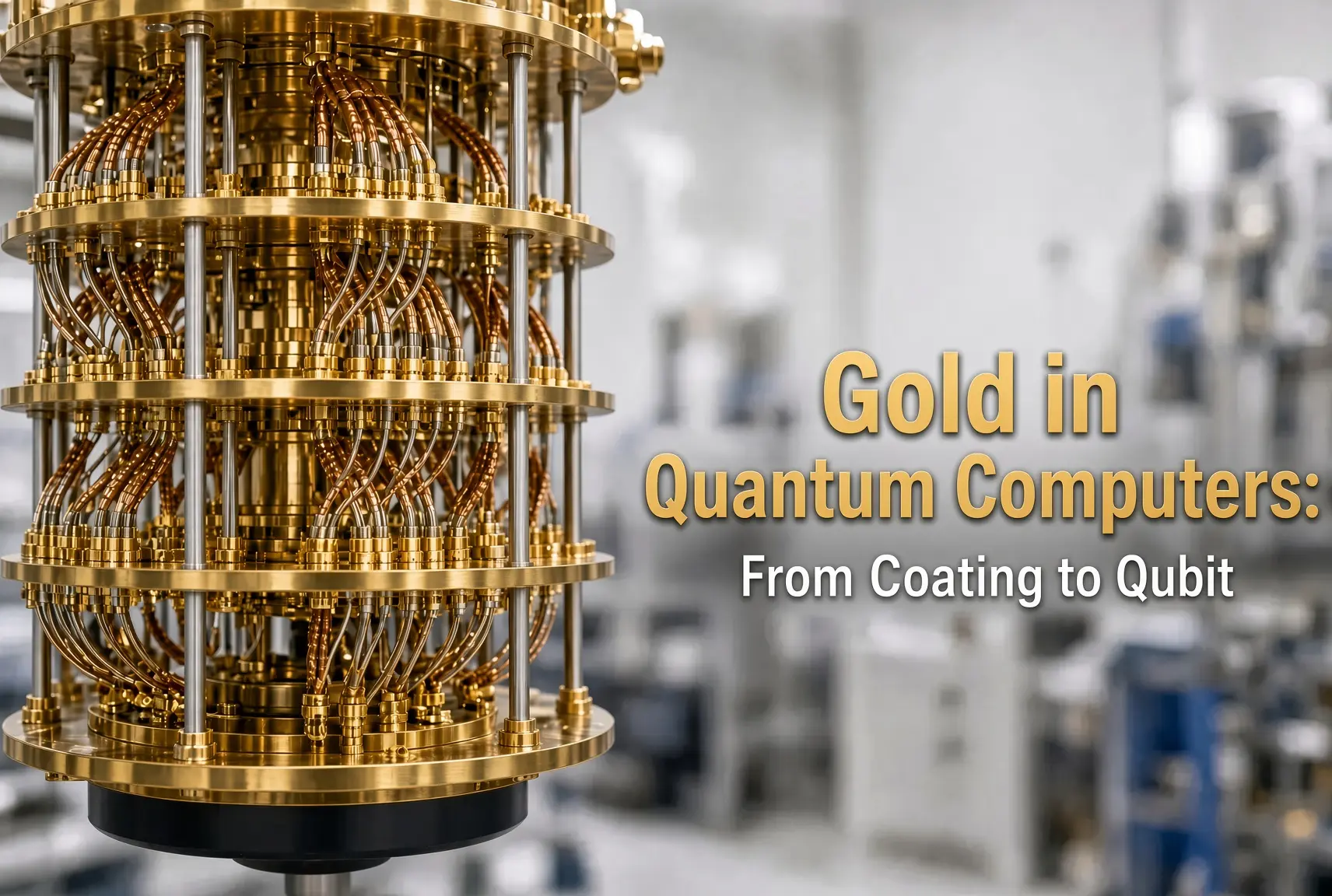
Blended states are also absurdly fragile, and that fragility dictates everything about how these machines are built. Heat is motion, motion is noise, and noise collapses a qubit back into a plain 0 or 1 before a calculation can finish. So the chip is held within a few thousandths of a degree of absolute zero — that is, of −273.15 °C, the temperature at which atomic motion stops — and so colder than deep space. Cooling it takes a machine far larger than the computer: a tiered structure of stacked discs and looping cable, plated in gold, hanging inside an open cylinder. It is known as the chandelier, and it is the object in nearly every photograph of a quantum computer. The computer itself is a chip roughly the size of a postage stamp, bolted underneath the bottom plate and usually hidden from view.
Gold is on that refrigerator for a mundane reason: it does not corrode, so the bolted joints that carry heat away from the chip keep working. What has changed is that gold stopped being only plumbing. In 2020 a team at MIT used it to host a kind of particle that could make quantum computers resist noise by their own structure rather than by brute force. In 2024 a coating of it made qubits hold their state two to five times longer. And in July 2026 a patterned film of it steered individual particles of light at room temperature, with no refrigeration at all — in an industry that spends its largest engineering budget on cooling.
Four different jobs — carrying heat out, sealing a superconductor, hosting a particle, steering light — running everywhere from room temperature down to thousandths of a degree above absolute zero. Two of them trace to a single fact about the atom: gold has 79 protons.
None of it is a gold market story, and the numbers say so plainly. A working quantum computer holds tens of grams of the metal inside a machine that costs millions, and the World Gold Council does not break quantum computing out as a line in its demand accounting at all. What is at stake is the job rather than the tonnage — whether gold stays a micron of plating on the outside of the machine, or becomes the material the computing happens in.
Gold Grows No Oxide and Grips Electron Spin
Gold’s Inner Electrons Move at Half the Speed of Light
Electrons closest to an atom’s nucleus are pulled by every proton in it, so the more protons an atom has, the faster those electrons travel. Gold’s 79 protons work out to roughly 58% of the speed of light — the ratio is close to the atomic number divided by 137. At that speed an electron starts behaving the way Einstein said things do when they move fast: it gains mass, and its orbit pulls in tighter.
The tightening does not stay buried in the core. It ripples outward to the outermost electrons, which are the ones that decide how an atom bonds to other atoms — in other words, its entire chemistry. Pekka Pyykkö and Jean-Paul Desclaux mapped the effect across the whole periodic table in Accounts of Chemical Research in 1979, in a survey of relativity and the periodic system of elements. The contraction rises and falls across the table and peaks at the coinage metals — copper, silver and gold — and in their words, “the pronounced local maximum of the contraction at gold… makes Au a unique element.”
Gold is not simply one more heavy metal where relativity shows up. Gold is the place in the periodic table where this effect is strongest, and you can confirm it without instruments: the contraction is also why gold is yellow rather than silver-coloured, since it pulls two of the atom’s energy levels close enough together that gold absorbs blue light instead of reflecting it. Silver, sitting directly above gold with 47 protons instead of 79, gets a far weaker effect and stays silver.
Two consequences of that contraction matter to a quantum computer, and the rest of this article runs on them: gold grows no oxide, and gold couples an electron’s motion unusually strongly to its magnetism. The first decides where gold sits inside the machines running today. The second is why physicists building the next generation keep choosing it.
Why Gold Grows No Oxide
Corrosion is a metal reacting with oxygen in the air to grow a surface layer of something else — an oxide, usually a poor conductor of both heat and electricity. Copper grows one about ten nanometres thick. Aluminium grows one about two nanometres thick. Gold grows none at all, and that single fact decides where every gram of gold in a quantum computer ends up.
Chemistry offers two competing explanations for why gold refuses, and they disagree about where the cause sits. The relativistic account puts it inside the atom: the contracted orbital lies so deep that gold holds onto its electrons rather than surrendering them to oxygen, leaving it — in Pyykkö and Desclaux’s phrase — “almost a halogen.” Surface science puts it at the boundary instead. In the 1995 Nature paper asking why gold is the noblest of all the metals, Hammer and Nørskov argue that gold’s electrons overlap so poorly with an approaching molecule that nothing sticks to it hard enough to react. Neither account has displaced the other, and neither disputes the outcome the engineering depends on.
Where Gold Sits in Today’s Quantum Computers
Almost all the gold in a working quantum computer is plating on the refrigerator rather than on the processor. It coats the joints, connectors and clamps that carry heat away from the chip, and its purpose only makes sense once you see how little heat these machines can tolerate. The exceptions come later: gold electrodes in a trapped-ion machine, and gold sealed under a superconducting circuit.
The Chandelier Runs 450 Times Colder Than Deep Space
The chandelier’s tiered plates hang one beneath another, each colder than the one above, like a staircase descending toward absolute zero. Sebastian Krinner and colleagues at ETH Zurich published the measured temperatures inside a commercial unit in their study of cryogenic setups for 100-qubit systems: 35 degrees above absolute zero at the top stage, falling to 6 thousandths of a degree at the bottom. NASA’s COBE satellite measured the leftover warmth of the universe itself at 2.725 degrees above absolute zero, in the FIRAS spectrum of the cosmic microwave background, so the bottom of a quantum computer runs about 450 times colder than the empty space between galaxies.
Gold Plating Cuts Joint Resistance Sevenfold
At the bottom of that staircase the machine can shed almost no heat at all. The commercial unit Krinner’s team measured is rated to remove 19 microwatts at 20 thousandths of a degree — millionths of a watt, roughly a twenty-thousandth of what a television draws on standby — and the team’s own measurement of their wired system came in lower, at 13 microwatts. Cooling power falls away steeply as the temperature drops, so at the 6-thousandth base there is less still. Every bolted joint carrying warmth away from the chip therefore has to conduct almost perfectly.
Gold plating is what makes that possible, and the size of the effect has been measured. Dhuley, at Fermilab, collected the published tests of pressed copper joints into a review of thermal contact resistance at low temperature. One study clamped identical plates at identical torque and changed only the surface. At 4.2 degrees above absolute zero the joint measured 0.6 K/W bare and clean, 0.9 once the copper had tarnished, and 0.08 gold-plated — kelvin of temperature drop per watt pushed across the joint, so lower is better. Plating improved the joint roughly sevenfold. Letting bare copper tarnish made it half as bad again.
Two mechanisms produce that gap and Dhuley names both. Gold’s low appetite for oxygen prevents the surface layer, so heat crosses the joint through metal contact instead of hitting an insulating film. And gold is softer than copper, so under a bolt it squashes into the microscopic valleys between two machined faces, turning apparent contact into real contact. The plating is a surface treatment for hardware that must be assembled by hand in open air and then survive being chilled to a few thousandths of a degree above absolute zero.
Follow that logic through the machine and gold turns up exactly where you would predict. Bronn and colleagues at IBM Research describe the company’s qubit package in a paper on plane-breaking packaging for superconducting qubits: a gold-plated copper base, a gold-plated copper interposer, and pogo pins of gold-plated beryllium copper 0.31 mm across — every one of them a connection that comes apart. The signal board beside them is silver-plated, because that joint is soldered and never opened — a tarnish that forms once and is then sealed inside the joint costs nothing, while a joint taken apart and remade tarnishes again every time. Trapped-ion machines, a different architecture that holds single electrically charged atoms in mid-air using electric fields, use gold in another way again. Pino and colleagues at Honeywell, now Quantinuum, report in their description of the trapped-ion quantum CCD architecture that the H1 processor suspends its ions above 198 gold electrodes, undercut-etched so that no insulating surface faces the ion — here the gold is the working part rather than a coating on plumbing.
What Gold Plating Costs the Qubit Above It
Gold is a trade-off in this role rather than a free win. Of the four metals in play it is only the third-best electrical conductor — 41.1 million siemens per metre at room temperature, behind silver at 63.0 and copper at 59.6, ahead of aluminium at 35.5 — and a casing that conducts less well drains more energy out of the qubit inside it. Huang and colleagues at MIT and MIT Lincoln Laboratory simulated how far different casing surfaces cap a qubit’s lifetime — how long it can hold its state before the casing itself drains it — in their study of microwave package design for superconducting quantum processors.
| Casing surface | Simulated ceiling on qubit lifetime | Against bare copper |
|---|---|---|
| Bare copper | 20 milliseconds | — |
| Gold-plated copper | 6 milliseconds | 0.3× |
| Copper coated in aluminium, which superconducts when cold | 5.83 seconds | 290× |
Gold-plated copper caps the qubit at 6 milliseconds against bare copper’s 20, and a superconducting aluminium coat beats both by a factor of roughly 300 to 1,000. The MIT authors put the trade in one line: gold-plating “limits the oxide formation at the cost of an increase in conductivity losses by up to one order of magnitude.” Today’s best qubits hold their state for a few hundred microseconds, so none of them is anywhere near even the gold-plated ceiling — the penalty is a limit on where the technology can go, not a brake on where it is.
One rule covers everywhere gold appears in these machines. Gold wins wherever a joint must be assembled by hand in air and then conduct heat near absolute zero, and loses everywhere the connection is permanent — which is why the cables running down the machine are stainless steel and niobium-titanium, the hair-thin wires bonding chip to package are aluminium, and the qubits themselves are niobium, aluminium and tantalum. Gold never superconducts, which keeps it out of every circuit that must be lossless. Gold never corrodes, which puts it on every surface that has to be pressed against another one.
How Much Gold Is in a Quantum Computer?
No manufacturer of these refrigerators, which engineers call cryostats, publishes a plating thickness, so this can only be answered to an order of magnitude, and the estimate below is built from one measured input and two assumed ones. The measured part is the metal itself: gold’s density is 19.32 grams per cubic centimetre, so a square metre plated one micrometre thick holds 19.3 grams. The assumed parts are the plated area and the plating thickness. A micrometre is the usual thickness for a hard-wearing engineering gold, and the plated parts inside a refrigerator — connectors, the bodies of the attenuators that damp incoming signals, thermal clamps and the chip mount — are thimble-sized, a handful per control line across a few hundred lines. Add their surfaces up and you get one to three square metres, which puts a working machine in the tens of grams. Not the hundreds, and not the single digits.
What is published is the cost of everything around it. Mohseni and colleagues at Hewlett Packard Labs, in an assessment of how to build a quantum supercomputer, put a cryostat for a 150-qubit processor wired with coaxial cable at about $5 million, with $4 million of that in wiring alone. At $4,356.90 an ounce, spot on 13 August 2026, tens of grams of gold comes to somewhere between $2,800 and $7,000 — so the cabling in that cryostat costs roughly six hundred times the metal inside it, and that is at the generous end of the estimate. Gold is in a quantum computer because of what it does at a surface, not because there is much of it.
Capping Niobium with Gold Makes Qubits Last Longer
A qubit’s usefulness comes down to a single number: how long it holds its blended state before the environment scrambles it. Physicists call it the coherence time; the figure quoted below is T1, the time an excited qubit takes to leak its energy away, which is measured in millionths of a second. Every extra microsecond means more computation before the answer dissolves. In 2024 a coating of gold raised it by a factor of between two and five.
Niobium Oxidises the Moment It Meets Air
Most superconducting qubits are built from niobium, a metal that superconducts at usefully high temperatures — and that starts growing an oxide the moment it meets air. The layer is only a few nanometres thick, a few dozen atoms, but it is riddled with defects that absorb energy at exactly the frequencies a qubit runs on. Verjauw and colleagues at imec showed how much damage that does by simply taking it away. Etching the oxide off niobium resonators with hydrofluoric acid cut the microwave loss by roughly an order of magnitude, they report in a study of microwave loss induced by oxide regrowth — and then the losses climbed straight back, doubling within about ten hours as the oxide regrew, in step with its thickness.
Corrosion at this scale is not a maintenance problem. A few nanometres of rust on a superconductor is the thing destroying the quantum state — which changes what gold’s refusal to corrode is actually worth, from a housekeeping convenience to a performance component.
Ten Nanometres of Gold, Two to Five Times the Lifetime
A team at Fermilab’s Superconducting Quantum Materials and Systems Center tried the obvious answer: strip the oxide off, then seal the surface before it can come back. Their recipe is to blast the niobium with argon ions for 15 minutes, evaporate 10 nanometres of gold onto the clean surface — a layer a few dozen atoms deep — and build the qubit circuit on top of the gold. Bal and colleagues report in npj Quantum Information, in a study of transmon coherence enabled by niobium surface encapsulation, that sealed devices held their quantum states two to five times longer than unsealed ones. That range is the paper’s headline for the whole encapsulation strategy, which it tested with four capping metals; the width of it comes from a bare-niobium baseline of only two devices, which themselves differed by a factor of 2.6.
| Surface treatment | Measured coherence times, µs, same chip design | Median |
|---|---|---|
| Bare niobium, left to oxidise | 54 and 21 | — |
| Niobium sealed with 10 nm gold | 27, 80, 100, 109, 120, 134, 137 | 109 µs |
| Niobium sealed with tantalum, same wafer | 102, 103, 118, 161 | 110 µs |
Gold was not the only metal that worked. In the paper’s own reading, gold and tantalum were the two best caps, both clearing a hundred microseconds on the sapphire wafer these devices were built on. Tantalum then pulled away on a silicon wafer with a different circuit layout, where it reached median lifetimes above 300 microseconds. Gold’s advantage is that it never oxidises at all, so a gold-capped surface does not depend on staying sealed.
Gold sitting directly beneath a superconducting circuit ought to ruin it, because ordinary metals soak up the energy a superconductor is supposed to carry without loss. It survives because of an effect called proximitisation: a thin enough layer of ordinary metal touching a superconductor borrows superconductivity from it and stops behaving like an ordinary metal. Chang and colleagues at Princeton and Brookhaven measured how much gets borrowed, in a study of eliminating surface oxides with noble metal encapsulation: the gold took on over 80% of the superconducting gap of the bare tantalum underneath it — the gap being the energy it costs to break superconductivity, and so a direct measure of how superconducting the gold had become. The Fermilab paper claims no mechanism of its own, attributing the whole gain to the removal of the niobium oxide.
Gold on Tantalum Changed Nothing
The same Princeton and Brookhaven measurement carries a second finding, and it runs the other way. Tantalum is another superconductor used for qubits, and laying gold down on it before the metal ever met air suppressed the tantalum oxide completely — yet the losses did not improve. Writing in Physical Review Letters in 2025, Chang and colleagues report that despite the suppression of surface oxides they see no improvement in surface loss, and slightly higher loss with the encapsulated films than with bare tantalum. Killing the oxide, on its own, bought nothing.
Geometry explains the contradiction, and it decides when sealing is worth doing at all. Their circuits are made by etching metal away, which leaves vertical side walls, and the same paper finds that the sidewall oxide accounts for more than 90% of the electric field energy at the metal-air interfaces. A coating applied from above lands on the top face and never reaches a side wall. Sealing the top surface is worth a great deal when the top surface carries the loss, and worth nothing when it does not — so whether gold helps a given qubit depends on how the chip was manufactured, not on chemistry.
Quantum Light, Sorted by Gold at Room Temperature
Cold is what a quantum computer spends its money on: the cryostat and the wiring that reaches down through it run to millions of dollars per processor, and every watt of heat that gets in has to be pumped back out. Anything that does a quantum job without cooling avoids that bill entirely. A device published in Nature on 15 July 2026 does exactly one such job — sorting light by a quantum property — at room temperature, with no cooling at all. It is a patterned film of gold.
A Gold Film with 100 Antennas Milled Into It
A team in Omar Magaña-Loaiza’s Quantum Photonics Laboratory at Louisiana State University took a film of gold and milled a pattern into it. Chenglong You, Riley B. Dawkins and colleagues describe the device in their paper on quantum statistical plasmonic metacrystals: gratings to let light in, plus 100 tiny antennas measuring 200 by 400 nanometres, cut into a gold film 110 nanometres thick, spaced a micrometre apart. Stack about a thousand films that thin and you would have something as thick as a sheet of paper.
What the pattern does has no everyday equivalent. Light can be described by how its photons — the individual particles light comes in — arrive at a detector. Photons from a laser arrive at random intervals. Photons from something hot, like a filament bulb, arrive in clumps. Photons from a single-photon source arrive strictly one at a time, evenly spaced. Those arrival patterns are called photon statistics, and in quantum optics they are not a side effect. They are part of the information the light carries.
The LSU device sorts light by that property. Its authors describe the result as the first room-temperature quantum material sensitive to the quantum statistics that distinguish one kind of light from another. An ordinary crystal blocks electrons at certain energies. This one has what the authors call forbidden quantum statistical bands: light whose photons arrive in one pattern passes, light whose photons arrive in another does not, and the two take different routes through the same piece of metal. The team confirmed it by measuring how bunched or spread out each stream was, using detectors that count photons one at a time.
The Gold Metacrystal Is a Component, Not a Computer
The metacrystal — the milled gold film, so called because its pattern acts on light the way a crystal lattice acts on electrons — is a component, not a computer: a patterned slab that filters a light beam, with no logic, no memory and no qubits of its own. Its authors present it as a step toward scalable many-body quantum technologies, and nothing about it removes the refrigerator from a mainstream quantum computer, which needs extreme cold for reasons that have nothing to do with light. Dawkins described its function in LSU’s announcement of 14 July 2026: “our crystal essentially acts as a statistical filter on quantum states.” Magaña-Loaiza, in the same release, named the prize: “our crystal can distinguish them and move them from one point to another in a robust way without requiring cryogenic cooling.”
What it does demonstrate is narrower: a quantum-optical job that normally demands cryogenic hardware can be done by a passive piece of patterned metal sitting on a bench. Gold is not protecting anything here or carrying heat away from anything. The metal is the optical medium — light interacts with gold’s own surface electrons, which ripple across it in waves that the milled pattern steers.
Majorana Modes in Gold Could Make Error-Proof Qubits
Every quantum computer being built today fights noise the same way: shield the machine, cool it hard, and then spend most of its qubits correcting the errors of the few doing actual work. A machine needing a million physical qubits to get a few thousand reliable ones is the direct consequence. A qubit that resisted noise by its own structure would change that arithmetic completely, and the leading proposal for building one runs on gold.
Gold Sits Between a Superconductor and a Magnet
The second of gold’s two useful properties is called spin–orbit coupling — the link between where an electron is travelling and which way its own tiny magnetism points. Heavy atoms tie the two together strongly, and that property is why a group led by Jagadeesh Moodera at MIT built its experiment on gold rather than something cheaper. Manna, Wei and colleagues write in their 2020 PNAS paper on a pair of Majorana zero modes in superconducting gold surface states that an important motivation for using the gold surface is its large Rashba spin–orbit coupling — the version of the effect that appears at a surface, where the atoms above and below an electron are different. On gold it splits the electron’s energy levels by 110 millielectronvolts, which the authors note is several orders of magnitude larger than in the semiconductor nanowires the field had been using.
The device is a sandwich: 20 nanometres of vanadium, then 4 nanometres of gold, then islands of europium sulphide two crystal layers thick. Vanadium supplies superconductivity — the ability to carry electricity with no resistance whatsoever — europium sulphide supplies magnetism, and the gold layer in between, patterned into wires about 100 nanometres wide, is where the interesting thing happens. Cooled to 0.38 degrees above absolute zero and placed in a 4.8-tesla magnetic field — against the 1.5 to 3 tesla of a hospital MRI scanner — the wires produced two separated spikes in electrical conductance, a measure of how easily current crosses into the wire, with one spike at each end.
The two spikes are the expected fingerprint of a pair of Majorana zero modes — strange disturbances in the electron sea that behave as their own antiparticles, so that a pair can annihilate each other, and which for that reason only ever appear in twos. A pair keeps its information between the two ends rather than at either one. A disturbance striking one end cannot read the information or corrupt it, because the information is not there. Manna and colleagues note that such pairs have been proposed as key ingredients of topological qubits protected from decoherence due to local noise sources — qubits that shrug off interference because of their shape rather than their shielding.
Majorana Evidence: Signature, Not Sighting
The conductance spike these experiments hunt for can also be produced by a far more ordinary effect called an Andreev bound state — an ordinary electron pair trapped at a boundary in a superconductor, which throws the same signal without being a Majorana mode at all. That ambiguity has already destroyed one flagship result. Zhang and colleagues at Delft and Microsoft retracted their 2018 Nature paper on quantized Majorana conductance on 8 March 2021, writing that after re-analysis “we can therefore no longer claim the observation of a quantized Majorana conductance.”
Manna and colleagues take the alternatives on directly, arguing that their wire and island end abruptly at the scale of single atoms, which rules out one route to a false signal, and that a defect-produced imitation would need careful tuning and could show up anywhere along the edge rather than only at the two ends. The team’s own count sets the scale of the claim. It studied about 60 europium sulphide islands; 20 showed a conductance spike at all, and four of those showed a matched pair at opposite ends. They add that in many cases they did not explore all the way around an island, so four is a floor rather than a rate. The paper’s title says “signature” rather than “observation,” and a platform that needs a fraction of a degree above absolute zero inside a 4.8-tesla magnet sits a long way from a working qubit.
Qubits Grown by Chemistry from Gold Clusters
Qubits are hard to mass-produce because they are carved. Each superconducting qubit is etched onto a chip by the same kind of lithography that makes ordinary microchips, and no two come out quite identical — which is one reason a thousand-qubit machine is far more than a hundred times harder than a ten-qubit one. A qubit that could be made by chemistry instead would sidestep the problem entirely, because molecules of a given kind are identical by definition.
Gold nanoclusters are one candidate. A nanocluster is a molecule of a few dozen to a few hundred gold atoms wrapped in a shell of organic molecules called ligands, and at that size it stops behaving like a fragment of metal and starts behaving like one enormous atom — which is why they are also called superatoms. Foxley and colleagues at Penn State and Colorado State report in ACS Central Science, in a study of the superatomic magnetic and spin properties of 144-atom gold clusters, that a single cluster type shows a range of magnetic responses — both paramagnetic and diamagnetic behaviour, opposite responses, in the same material.
The outer shell steers the result. Smith and colleagues in the same collaboration swapped the ligand on a 25-atom cluster and measured the light it gives off, reporting in the Journal of Physical Chemistry Letters on the influence of passivating ligand identity on spin-polarized emission. Spin-polarized emission means the emitted light carries a preferred handedness, which is how the cluster’s own spin state can be read out — and swapping an aromatic ligand for an aliphatic one changed it five-fold. Penn State’s announcement gives the same result in absolute terms: 7% spin polarization in one wrapping, approaching 40% in the other, which the group’s Ken Knappenberger called competitive with some of the leading two-dimensional quantum materials. The paper attributes the weaker case to energy leaking away through non-radiative channels rather than to any change in the gold core’s own magnetism.
The Money Behind Quantum Computing
Investment in quantum technology start-ups reached $12.6 billion in 2025, 6.3 times the previous year’s figure, with 90% of it going to quantum computing companies, according to McKinsey’s Quantum Technology Monitor 2026, published in April 2026. Against that spending, quantum computing companies booked just over $1 billion of revenue worldwide in the same year, which McKinsey projects could reach $4.4 billion by 2028. On matched scope that is about eleven dollars of investment for every dollar of revenue. IBM announced on 2 June 2026 that it would put more than $10 billion into quantum over five years, and its published roadmap targets Starling, its first large-scale fault-tolerant machine, for 2029.
The listed pure-play companies are not one group but a spread. IonQ reported record second-quarter revenue on 5 August 2026 of $80.1 million, up 287% on the year before. Quantinuum, which listed on Nasdaq in June 2026 at $60 a share and raised $1.68 billion gross, reported $8 million on 11 August 2026, its first results as a public company. Rigetti reported $5.1 million. The suppliers underneath them are not smaller. Finland’s Bluefors, which builds the refrigerators, reports EUR 217 million of revenue for 2025 and more than 1,700 cryogenic systems delivered since it was founded — more revenue in a year than any of the listed pure-plays, and it is not listed.
The cryogenics layer is where this article’s own subject cuts against the industry’s shape. Helium-3, the rare form of helium these refrigerators use to reach their lowest temperatures, occurs on Earth only in traces, and the US government’s entire supply is a by-product of tritium decay separated during weapons-stockpile processing at the Savannah River Site, according to the Department of Energy’s helium-3 supply and demand pages. Bluefors has contracted Interlune for up to 10,000 litres a year of helium-3 mined on the Moon from 2028 to 2037 — more, on its own, than the under-6,000 litres a year of federal demand the DOE currently projects. That constraint exists only for machines that have to be cold. Cryogenics is the corner of quantum hardware selling the most hardware today, and it is the corner a room-temperature architecture would have least need of.
Gold demand is not part of this story, despite gold appearing throughout the machines. The World Gold Council’s Gold Demand Trends for full-year 2025 puts all technology demand at 322.8 tonnes and electronics at 270.4 tonnes; its Q2 2026 edition, published on 30 July 2026, puts the quarter at 80.4 and 68.3 tonnes. Neither breaks quantum computing out as a line, and at grams per machine across a few thousand machines worldwide it would round to nothing if they did. Ordinary computing is where gold and chips meet at scale: the Council attributes the growth in electronics demand to the AI boom, with high-speed computing accelerating the use of bonding wire and contact and interconnect materials — while noting that manufacturers are pursuing aggressive thrifting strategies to use less gold per part. A single AI server rack moves more gold than a quantum computer does.
What Quantum Computing Means for Investors
The layer of the industry with the most dependable revenue is the layer least available to buy. Bluefors, whose refrigerators nearly every superconducting machine depends on, is privately held in Finland. Quantum Design, which completed its purchase of Oxford Instruments’ NanoScience division on 2 January 2026, is a private corporation in San Diego. What is listed is mostly the machine builders, whose combined quarterly revenue is smaller than one supplier’s annual figure.
| Company | Listing | Approach | Latest reported |
|---|---|---|---|
| IonQ | NYSE: IONQ | Trapped ion | Q2 2026 revenue $80.1m, up 287% year on year; full-year guidance $280–290m |
| Quantinuum | Nasdaq: QNT | Trapped ion | Q2 2026 revenue $8m, up 279% year on year; first guidance as a public company, $28–32m for 2026. Listed June 2026 at $60 a share, raising $1.68bn gross |
| Rigetti Computing | Nasdaq: RGTI | Superconducting | Q2 2026 revenue $5.1m against $1.8m a year earlier; $541.3m cash and no debt |
| D-Wave Quantum | Nasdaq: QBTS | Annealing and gate-model | Q2 2026 revenue $3.1m, flat against the same quarter of 2025 |
| IBM | NYSE: IBM | Superconducting | Committed more than $10bn to quantum over five years in June 2026; Starling, its first large-scale fault-tolerant machine, targeted for 2029 |
Across the same three months of 2026, IonQ booked $80.1 million, Quantinuum $8 million, Rigetti $5.1 million and D-Wave $3.1 million. Four companies that trade under the same label differ from one another by a factor of twenty-six in revenue. The largest programmes of all sit inside IBM, Google and Microsoft, where quantum spending runs to billions but arrives inside financial statements measured in hundreds of billions, so a share in any of them is overwhelmingly a share in something else.
Funds are the other route, and the largest quantum-labelled one holds a good deal that is not quantum. The Defiance Quantum ETF (QTUM, Nasdaq), issued by Defiance ETFs and structured as an open-end fund registered under the US Investment Company Act of 1940, held $5.76 billion across 89 positions as of 12 August 2026, at an expense ratio of 0.40% a year. It tracks an index whose full name states the scope the ticker hides: the BlueStar Machine Learning and Quantum Computing Index. Its ten largest holdings on 13 August 2026 were Arqit Quantum, Horizon Quantum, Cloudflare, Snowflake, Radnet, Palantir, Nutanix, Hewlett Packard Enterprise, Quantinuum and Global Unichip, each between 1.44% and 2.03% of the fund. Three of the ten are quantum pure-plays; the rest are machine-learning, data-infrastructure, semiconductor and medical-imaging companies.
The gap between the sector’s spending and its revenue is a question of dates. No machine has yet beaten a conventional computer at a commercially useful task, and IBM’s own fault-tolerance roadmap puts its first large-scale error-corrected system in 2029 — so today’s revenues come from research contracts and cloud access rather than from work only a quantum computer can do. On the materials question this article opened with, gold is not a way to own any of it: tens of grams a machine buys no exposure at any plausible scale. The physical input that is genuinely scarce is helium-3, and it is not listed either, since the supply agreement runs between two private companies.
Nothing in this section is a recommendation to buy, sell, or hold any security. It is general information only, and the figures above are those most recently reported at the time of writing.
The Future for Gold in Quantum Computing
Gold’s future in quantum computing is a question about its job, not its tonnage. The quantities stay trivial under every scenario — tens of grams a machine, across a few thousand machines. What is unsettled is whether gold remains a coating on the plumbing or becomes the material the computation happens in, and that is decided by which architecture turns out to work. Four routes are live, and each puts gold somewhere different.
| Route | Where gold ends up | Evidence so far |
|---|---|---|
| Superconducting processors — in service now | Plating on every joint that comes apart; possibly a 10 nm cap beneath the circuit | Sevenfold better thermal joints, measured; gold-capped niobium at a 109 µs median, and the same trick on tantalum gave nothing |
| Photonic machines — one component demonstrated | The patterned metal is the optical element itself | A published, working room-temperature device that filters light by its photon statistics — a part, not a processor |
| Topological qubits — a proposal | Gold is the material the quantum state lives in | Paired conductance spikes on four of about 60 islands, at 0.38 K in a 4.8-tesla field |
| Chemically grown qubits — a proposal | The gold cluster is the qubit | Spin polarization tuned from 7% to near 40% by swapping a ligand; no coherence time published |
Ranked by evidence rather than by ambition, the four come out in roughly the reverse order. Capping is the only one that has measurably improved a working qubit, and even there a second laboratory got nothing on a different superconductor. The metacrystal is a real device that does a real job, and it is a component. The Majorana signature rests on four islands. The nanoclusters have not yet been asked to hold a quantum state for a measured length of time. Only the first route is in service; the other three are proposals, with a working device behind exactly one of them.
IBM has put a date on when this stops being a laboratory question. The company’s fault-tolerance roadmap commits to delivering Starling, its first large-scale error-corrected machine, in 2029. Until something at that scale runs, gold’s role in quantum computing is what it has been for a decade: a micron of plating doing an unglamorous job extremely well, while three separate research programmes try to promote it into something else.


